




China’s Eight Ministries Jointly Issue Work Plan to Improve the Carbon Emissions Statistics and Accounting System
 Printing
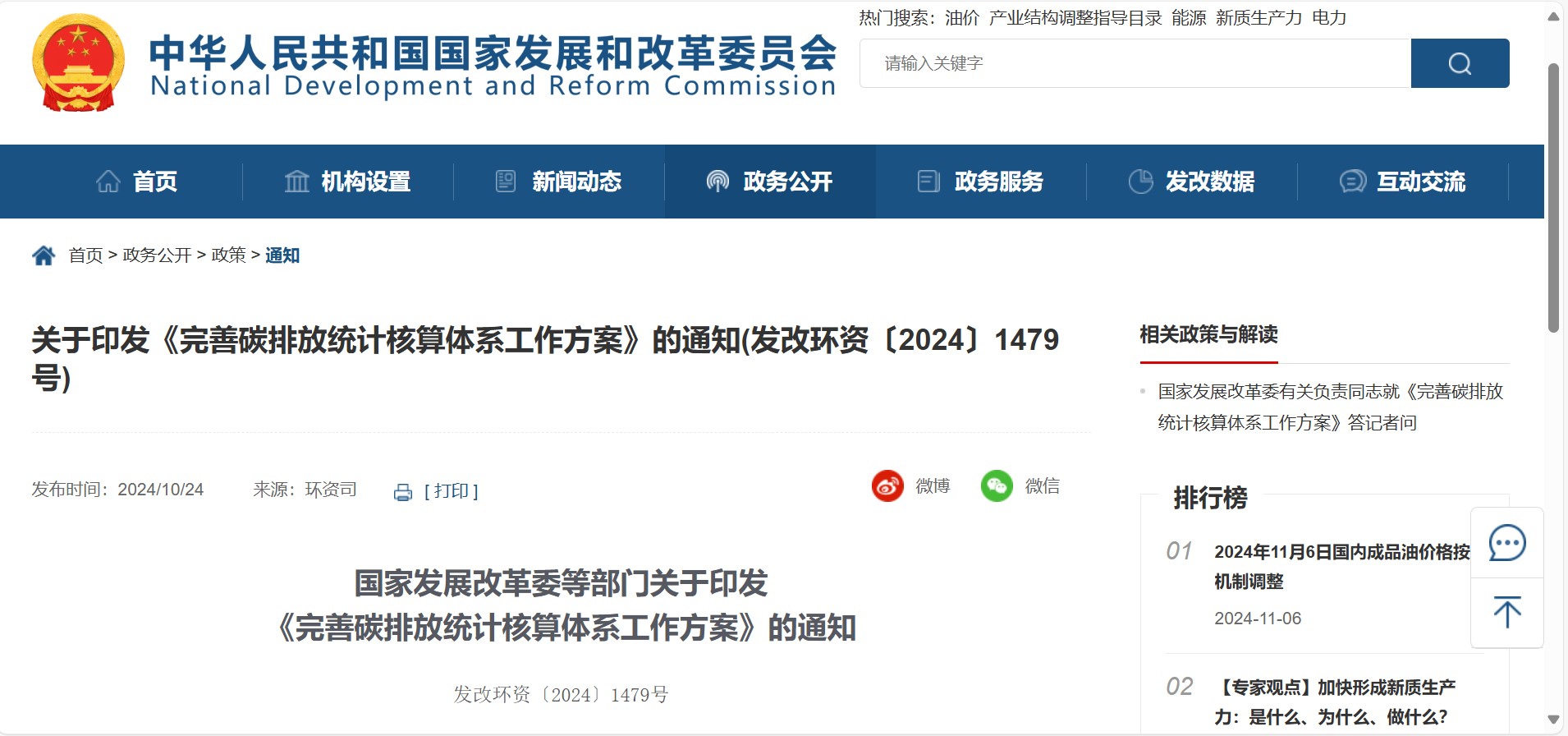
In order to accelerate the basic system of dual control of carbon emissions and build a sound statistics and accounting system, eight ministries, including the National Development and Reform Commission, the Ministry of Ecology and Environment, the National Bureau of Statistics, and the Ministry of Housing and Urban-Rural Development, have formulated the ‘Work Plan for Improving the Carbon Emission Statistics and Accounting System’ (hereinafter referred to as the ‘Plan’), which has been released recently.
In order to accelerate the basic system of dual control of carbon emissions and build a sound statistics and accounting system, eight ministries, including the National Development and Reform Commission, the Ministry of Ecology and Environment, the National Bureau of Statistics, and the Ministry of Housing and Urban-Rural Development, have formulated the 'Work Plan for Improving the Carbon Emission Statistics and Accounting System' (hereinafter referred to as the 'Plan'), which has been released recently.
Improving the statistics and accounting system for carbon emissions is a systematic project and a long-term task. Focusing on the construction of controlling the total amount and intensity of carbon emissions, the Plan adheres to the combination of long and short terms, and proposes two main objectives at two stages.
The first stage is from now to 2025, focusing on consolidating the data foundation of carbon emissions, comprehensively establishing the system of annual reports and letters of carbon emissions, focusing on perfecting the calculating system and methodology of carbon emissions of enterprises and products in the region and industry, and constructing a database of China’s greenhouse gas emission factors, so as to provide data support for the implementation of controlling the total amount and intensity of carbon emissions nationwide during the period of the ‘Tenth Five-Year Plan’.
The second stage is from 2026 to 2030, with the focus on comprehensively improving the level of carbon emission calculating capacity, constructing a systematic and complete carbon emission statistics and accounting system, and promoting the soundness of the relevant carbon emission statistics and accounting system, standards and rules, management mechanism and methodological research, so as to ensure that the carbon emission data can effectively satisfy the requirements for the control and management of carbon emissions at all levels, in all fields and all industries.
The Plan focuses on serving local carbon assessment, industry carbon control, enterprise carbon management, project carbon evaluation, product carbon footprint, etc., and focuses on promoting the improvement of carbon emission accounting systems and standards at the regional, industry, enterprise, project, product and other levels, and specifies 23 specific tasks in 8 areas, and, according to the division of responsibilities, the Ministry of Housing and Urban-Rural Development, together with the relevant ministries, is responsible for the following 4 tasks:
Give full play to the roles of competent industry ministries and industry associations, focusing on industrial industries such as building materials, petrochemicals and chemicals, as well as urban and rural construction, transport and other fields, and reasonably delineate the scope of carbon emission accounting for industry sectors according to the characteristics of the industry and the needs of management, and relying on data from energy and industrial statistics, accounting of carbon emissions from energy activities and industrial processes, the national carbon emissions trading market, the green certificate trading market, etc., carrying out carbon emission accounting for key industry sectors.
Study and formulate carbon emission accounting guidelines for fixed-asset investment projects, carry out research on carbon emission evaluation methods for fixed asset investment projects based on the theory of the whole life cycle, and study on setting carbon emission access levels for fixed asset investment projects in key industries.
Study and formulate technical standards, norms or guidelines for the evaluation of the environmental impact of greenhouse gas emissions from construction projects in key industries, and improve the technical system of environmental impact evaluation.
Formulate a plan for the construction of a national greenhouse gas emission factor database, organize the development and construction of the factor database, establish a supporting management system, standardize the data management and daily operation, and publish as soon as possible a batch of carbon emission factors of major energy categories and key basic products, so as to provide baseline data for localities and enterprises to carry out accounting.
In terms of organization and implementation, the Plan stresses that the eight ministries will strengthen work coordination, to establish a coordination mechanism for carbon emission statistics and accounting: coordinating important policies, strengthening data management, enhancing data application, carrying out basic research, and promoting the formation of work synergies. In accordance with the principle of ‘Who Accounts For, Who Manages, Who Is Responsible For’, the management and application of carbon emission data will be strengthened in the whole country, as well as in all regions and industries. Facing requirements of controlling the total amount and intensity of carbon emissions, the relevant ministries should do a good job in summarizing, hierarchically managing and sharing carbon emission data among ministries, relying on the relevant data to carry out situation research and judgement, reminder and early warning, evaluation and assessment, etc., and the relevant analyses should be timely shared with the ministries who provides the data. Each region should formulate a specific plan for the implementation of the relevant work, effectively strengthen the construction of a statistics and accounting system for carbon emissions in the region, consolidate the relevant foundations, and perform well at analyzing the outlook for carbon emissions in the region in a forward-looking manner.
Editor's Choice


Get the latest updates with our newsletter
Follow us
-

CCPA Wechat
-

CCPA EXPO Wechat
