




A Review of the Super Projects Along the Belt and Road Initiative
As a series of key BRI projects undertaken overseas by leading Chinese construction enterprises, such as CSCEC, CCCC and CRCC, take root and flourish, they not only drive infrastructure development and economic growth in partner countries but also establish a globally renowned “China Brand.”
The “hard connectivity” of infrastructure is a fundamental pillar of the Belt and Road Initiative. President Xi Jinping has emphasized the need to promote an integrated connectivity system across land, sea, air, and cyberspace, focusing on key corridors, key cities, and key projects to link the road and rail networks on land and the network of sea ports.
Over the years, projects such as the China-Laos Railway and the Jakarta-Bandung High-Speed Railway have been completed and put into operation. These infrastructure projects, spanning mountains and seas, have demonstrated the solid strength and remarkable achievements of "hard connectivity," enhancing connectivity among BRI partner countries and providing strong support for the stable and smooth operation of global industrial and supply chains.
As a series of key BRI projects undertaken overseas by leading Chinese construction enterprises, such as China State Construction Engineering Corporation (CSCEC), China Communications Construction Company Limited (CCCC), and China Railway Construction Corporation Limited (CRCC), take root and flourish, they not only drive infrastructure development and economic growth in partner countries but also establish a globally renowned “China Brand.”
1. The First Overseas Railway Built to Chinese Standards—China-Laos Railway
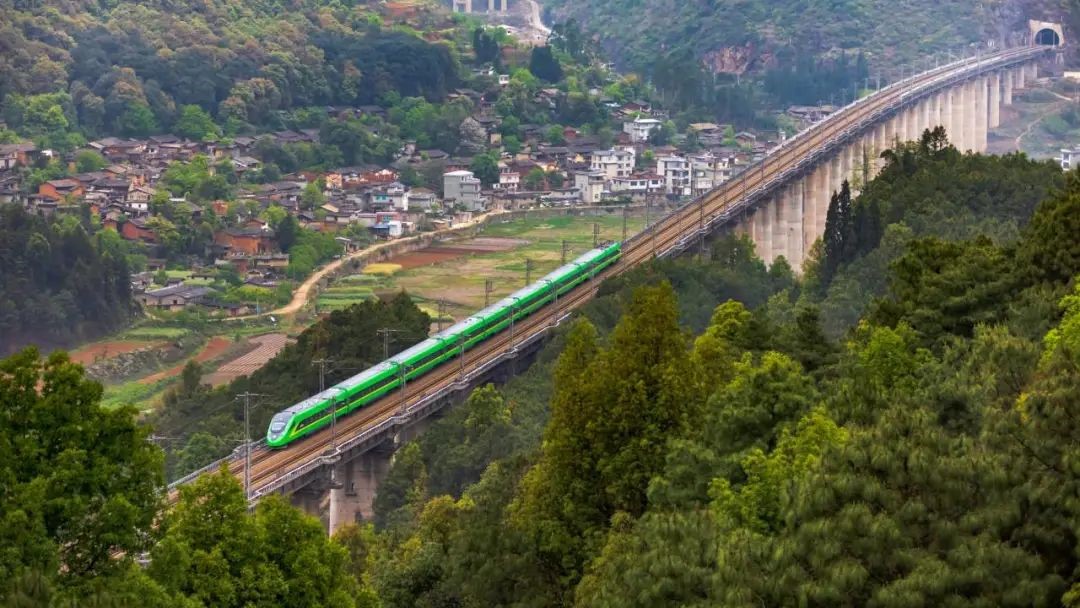
As a landmark project of the Belt and Road Initiative (BRI), the China-Laos Railway is the first overseas railway constructed and operated through China-Laos cooperation while fully adopting Chinese standards and directly connecting to China’s railway network. The railway links Kunming, Yunnan Province, China, to Vientiane, the capital of Laos. The project was built by China Railway Group Limited (CRG) and China Railway Construction Corporation Limited (CRCC), with the Chinese section spanning 508.53 km and the Lao section covering 414 km. Designed for a speed of 160 km/h, the total investment in the project amounted to 50.545 billion yuan, with a construction period of five years. It officially commenced operations in 2021.
Crossing mountains, rivers, and farmlands, every inch of progress in the China-Laos Railway was made possible by the relentless efforts of its builders. Since its launch, the number of cross-border freight trains has increased significantly, along with the train traction capacity. The daily freight train services have surged from just two at the beginning to 18 today, with the traction load increasing from 2,000 t to 2,500 t. Behind these soaring figures lies the continuous enhancement of the railway’s capacity and efficiency. The cumulative transportation of cross-border cargo reached 11.58 million t, which is not only a figure, but also a strong proof of the increasingly frequent trade exchanges and deepening cooperation between China and Laos.
The China-Laos Railway acts as a “golden key,” helping Laos overcome its geographical challenge as a landlocked country while opening a major corridor extending to Myanmar, Thailand, and other nations in the heart of the Indochina Peninsula. With its operation, the Pan-Asian railway network has taken a clearer shape, strengthening connectivity between China and Southeast Asian countries and setting a new milestone for regional integration.
2. China’s First Overseas High-Speed Railway—Jakarta-Bandung High-Speed Railway
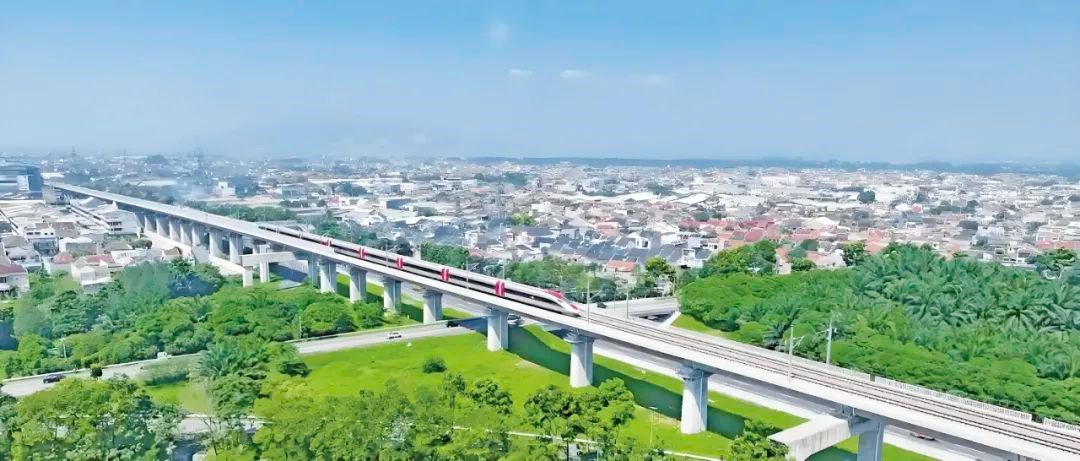
The Jakarta-Bandung High-Speed Railway (HSR) stands as a flagship project of China-Indonesia Belt and Road cooperation and marks the first time that China’s high-speed railway system, technology, and entire industrial chain have been fully implemented overseas. As China’s first overseas HSR project, it is also Southeast Asia’s first high-speed railway, connecting Jakarta, the capital of Indonesia, with Bandung. The project fully adopts Chinese design, construction, equipment, and standards, making it a milestone in China’s high-speed rail “going out.” Constructed primarily by China Railway Group Limited (CRG), the Jakarta-Bandung HSR spans 142.3 km, with a designed speed of 350 km/h. Full-scale construction began in June 2018 with a planned duration of 36 months. The railway features four stations along the route and, since its launch in 2023, has dramatically shortened travel time between Jakarta and Bandung from over three hours to just 40 minutes.
By 2024, the Jakarta-Bandung HSR had completed its first full year of operation, transporting a total of 5.79 million passengers, with a peak daily occupancy rate of 99.6%. Its high-speed trains have safely covered over 2.57 million km. The railway has significantly improved local transportation, making travel more convenient for residents along the route, stimulating commercial development, and boosting the tourism industry. It has injected fresh momentum into regional economic and social development and plays a crucial role in deepening practical cooperation between China and Indonesia while accelerating the realization of the China-Indonesia community with a shared future.
3. The “Hong Kong-Zhuhai-Macao Bridge” of Europe—Pelješac Bridge
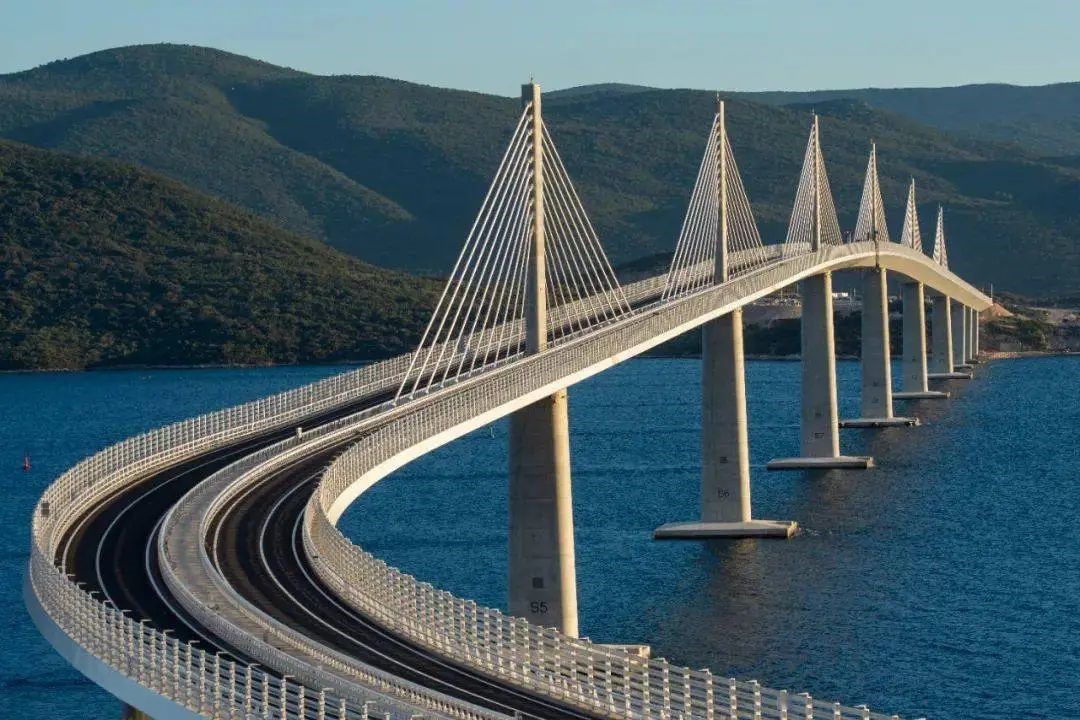
The Pelješac Bridge is the largest infrastructure project undertaken in Croatia by a Chinese construction company and the first project within the European Union to be implemented using EU funds, built to EU standards, and awarded through a global bidding process. Due to its construction techniques being similar to those of the Hong Kong-Zhuhai-Macao Bridge, and with engineers from that project also involved in its construction, the Pelješac Bridge has been dubbed the “Hong Kong-Zhuhai-Macao Bridge of Europe.”
In 2018, a consortium led by China Road and Bridge Corporation (CRBC), along with CCCC Second Highway Engineering Co., Ltd. and CCCC Highway Consultants Co., Ltd., won the bid for the bridge project, with a contract value of 280 million euros. This marked the first time a Chinese company had secured a project funded by the EU, and it remains the largest single EU-funded project undertaken by a Chinese enterprise. The Pelješac Bridge, with a total length of 2,440 m, width of 22.5 m, and a two-way two-lane highway deck, started construction in July 2018 by the Chinese side, and will be officially opened to traffic in July 2022. During the construction of the Pelješac Bridge, the project team called on the world's largest piling ship “Xiong Cheng No. 1” to drive the world's longest steel pipe piles of 130.6 m in one go, which not only shortened the piling time, but also created a world record.
The Pelješac Bridge is a testament to the strength of Chinese enterprises in international infrastructure projects, having been awarded through an open and transparent bidding process. More than just a vital link connecting mainland Croatia with the Pelješac Peninsula, the bridge stands as a significant achievement of China-Croatia Belt and Road cooperation. Its completion has greatly improved local transportation, boosted regional development, and served as a model for pragmatic cooperation between China and the European Union.
4. Lusail Stadium Featured on Qatari Banknotes
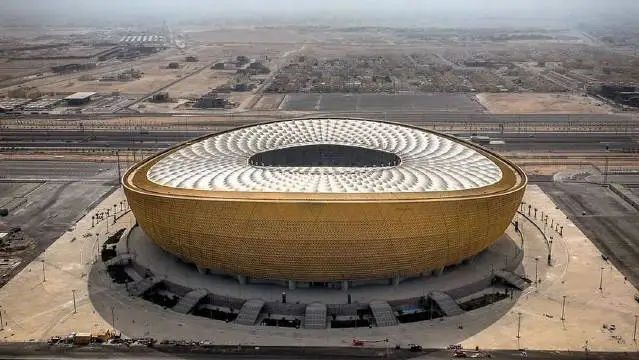
Lusail Stadium is located in Lusail City, approximately 15 km from Doha, the capital of Qatar. Covering a construction area of 195,000 m2, the stadium can accommodate up to 92,000 spectators. Its design is inspired by traditional Qatari lantern patterns and date bowls, featuring a bowl-shaped exterior, a saddle-shaped roof, and a golden double-curved aluminum façade, making it resemble a giant golden bowl when viewed from above.
Lusail Stadium is the first FIFA World Cup main stadium to be constructed by a Chinese company. China Railway Construction Corporation (International) Limited served as the general contractor for the design and construction. The project commenced on November 21, 2016, with the main structure completed in September 2021 and full completion achieved in September 2022. It stands as the largest and most capacious professional stadium ever built overseas by a Chinese enterprise, with the total amount of steel used in its structure equivalent to that of three Eiffel Towers. Over 2,118 days, China Railway Construction Corporation (International) Limited collaborated with 110 companies from more than 20 countries and thousands of workers to create this architectural marvel, known as the "Golden Bowl" of the Gulf region. From design to construction, Lusail Stadium has set multiple world records. Notably, it is the largest single-building structure featuring a double-layered cable-net roof, with a record-breaking span of 274 m.
In December 2020, the Central Bank of Qatar officially released the country’s fifth series of Qatari riyal banknotes. The new 10-riyal note features an illustration of Lusail Stadium—marking the first time a “Made in China” project has appeared on Qatari currency.
5. The Terminus of the China-Pakistan Economic Corridor—Gwadar Port
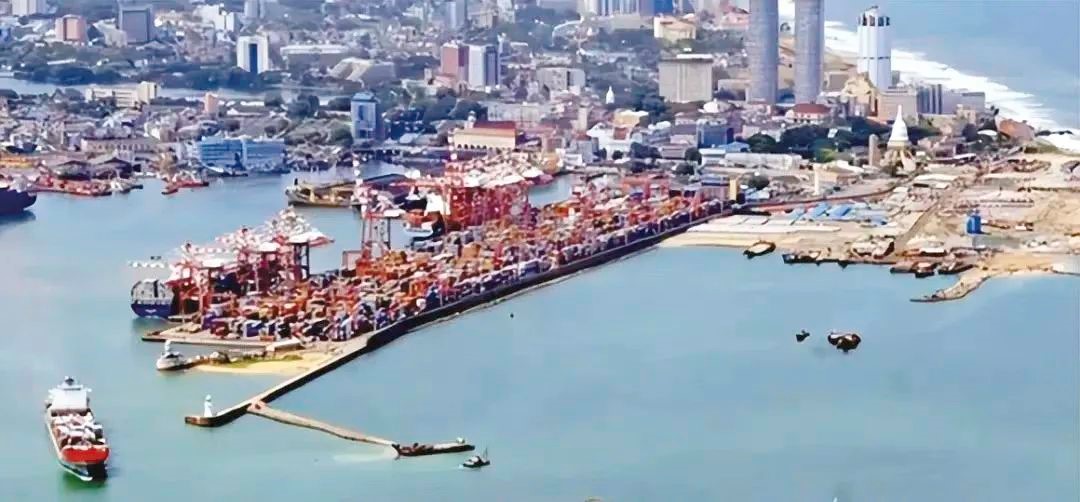
Gwadar Port is one of the cornerstone projects of the China-Pakistan Economic Corridor (CPEC) and is located in Pakistan’s Balochistan province. Constructed by China Communications Construction Company (CCCC), the project includes port infrastructure development and the establishment of a free trade zone. In 2013, China formally signed an agreement with Pakistan to take over the development and operation of Gwadar Port, which officially began operations in 2016.
Before its development, Gwadar was merely a small fishing village in southwestern Pakistan, isolated from the capital, Islamabad, and inland commercial hubs due to poor transportation infrastructure. However, with the rise of Gwadar Port, the region has undergone a dramatic transformation. The gradual improvement of the port and its supporting facilities has turned it into a crucial hub for Pakistan’s maritime and land-based transport network. Today, Gwadar Port is closely connected to Karachi Port in the east and extends westward via highways to the Iranian border. The southern coastline of Pakistan is now effectively integrated, and its links to Islamabad have been significantly strengthened, alleviating inland-coastal transportation bottlenecks and boosting import-export trade.
The successful development of Gwadar Port marks a significant step forward in China’s strategic global presence. This project not only enhances economic ties between China and Pakistan but also provides China with a key geopolitical advantage in the region. It plays a crucial role in securing China’s energy supply and facilitating logistics and transportation on a broader scale.
6. "The Pyramid of the New Era"—Central Business District of Egypt’s New Administrative Capital
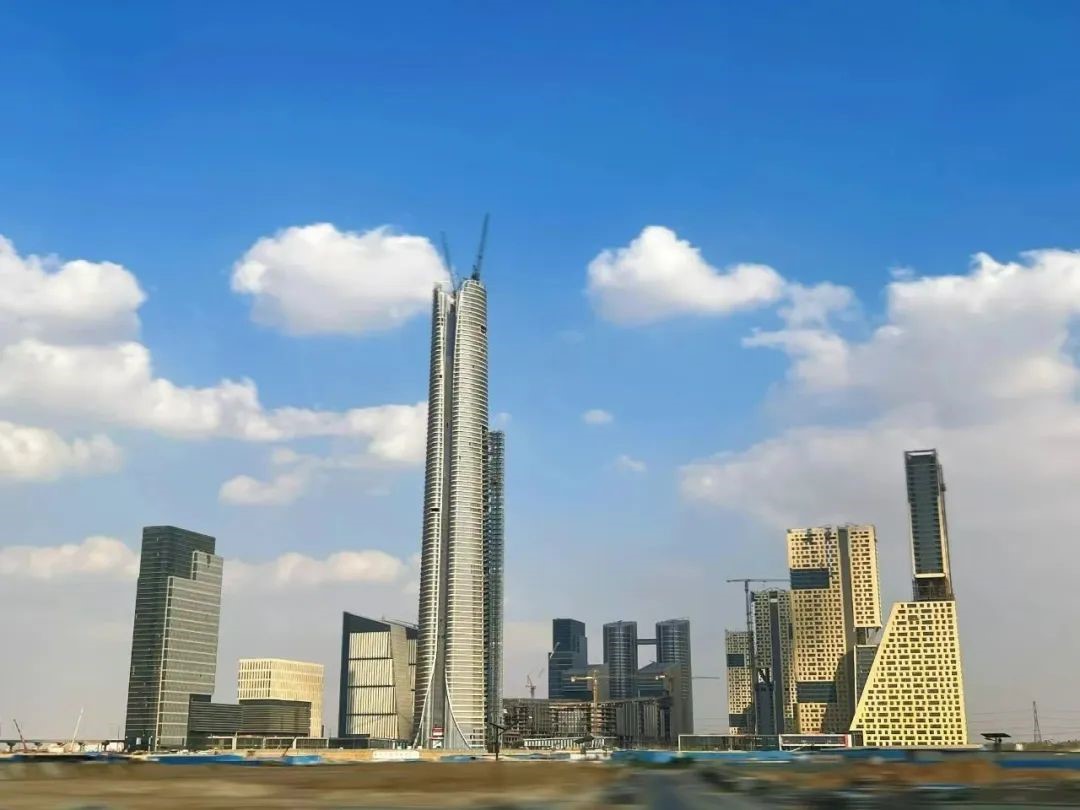
Rising from the desert 50 kilometers east of Cairo, a modern metropolis is taking shape—the Central Business District (CBD) of Egypt’s New Administrative Capital, a flagship project under the China-Egypt Belt and Road Initiative. Covering an area of approximately 505,000 m2, the project officially commenced on March 18, 2018. Comprising 20 high-rise buildings and supporting municipal infrastructure, with a total construction area of about 1.7 million m2, the CBD is the largest project undertaken by a Chinese enterprise in Egypt, built by China State Construction Engineering Corporation (CSCEC).
The most striking structure within the CBD is the soon-to-be-completed "Tallest Building in Africa." Standing at 385.8 m, this multifunctional skyscraper integrates office spaces, hotels, residences, and recreational facilities, dubbed the "Pyramid of the New Era" by Egyptians.
For nearly four decades, Egypt has focused its urban development on constructing new cities. Over the past five years, 30,000 Egyptian workers and nearly 10,000 Chinese builders have been working in the desert for five years. The CBD, serving as the core hub of the new capital, is on the verge of completion. Here, the world-class business district will intersect with the Red Sea Economic Belt and the Suez Canal Economic Zone. The Belt and Road Initiative has revitalized the ancient Silk Road, breathing new life into historical trade routes. Through consultation, collaboration, and shared benefits, the transformation of deserts and coastlines stands as a testament to the fruitful and pragmatic cooperation between China and Arab nations.


Get the latest updates with our newsletter
Follow us
-

CCPA Wechat
-

CCPA EXPO Wechat
