




CSCEC Built a New 452-Meter Kuala Lumpur Landmark in 33 Months
Just 2.5 km from the iconic Petronas Twin Towers, a new landmark has risen, reflecting Kuala Lumpur’s ambitious vision for the future.
Kuala Lumpur is renowned for its beautiful temples, bustling markets, and towering skyscrapers. Like many other global cities, it showcases these engineering marvels as symbols of its rapid economic growth. Just 2.5 km from the iconic Petronas Twin Towers, a new landmark has risen, reflecting Kuala Lumpur’s ambitious vision for the future.
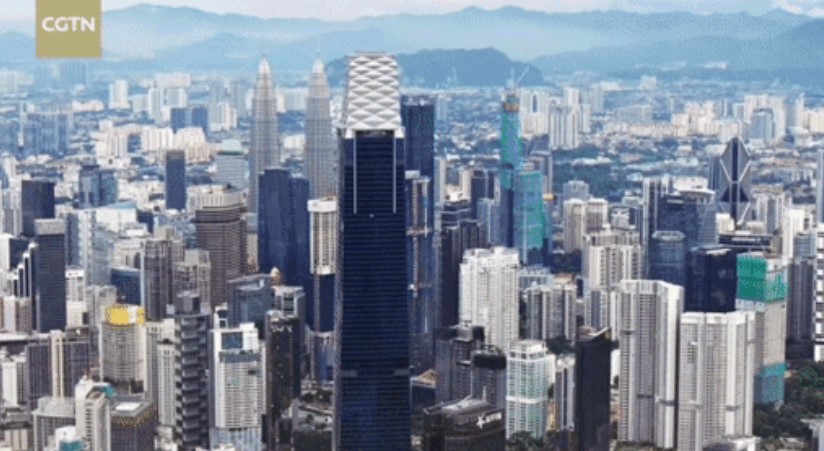
Malaysia aims to become a high-income and fully developed nation by 2025. One of its key initiatives is establishing the country’s first international financial center to rival those in London, Hong Kong, and Singapore.
Following Syazwan, a safety officer at China State Construction Engineering Corporation (CSCEC) in Malaysia, the reporter arrived at the Tun Razak Exchange (TRX) district, which is planned to host the headquarters of major banks and serve as a newly developed financial hub in the city center. "The Exchange 106 is one of the most important landmark buildings designed for this district, standing at 1,600 feet (approximately 452 meters) tall," Syazwan explained to the reporter.
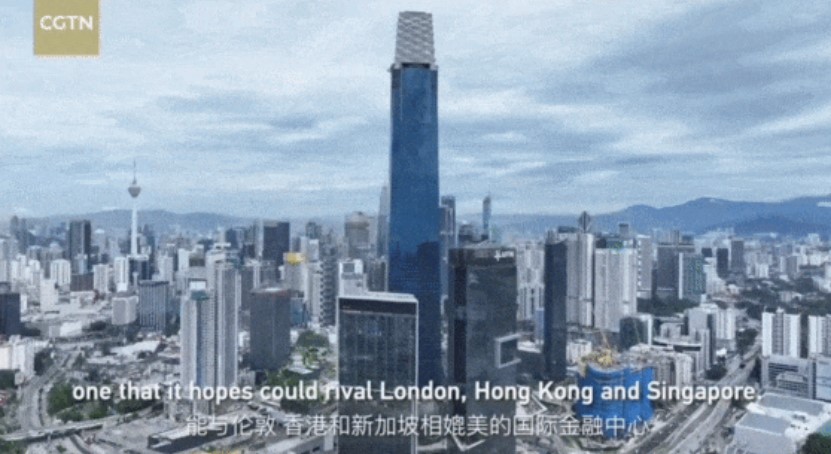
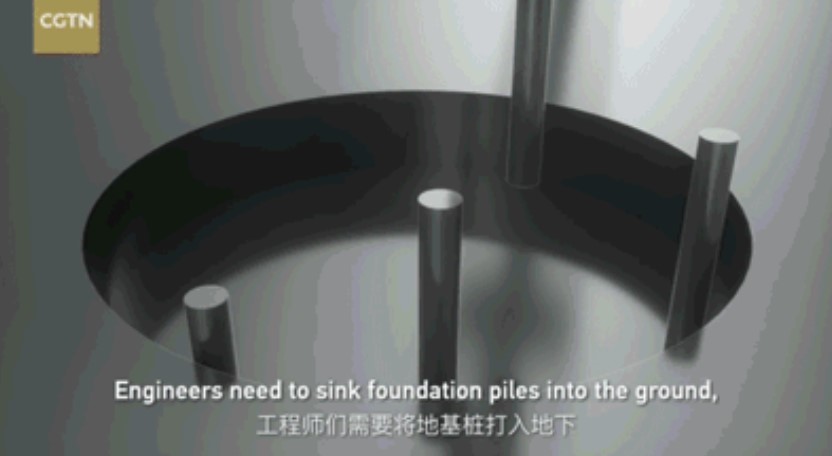
A solid foundation is the key to construction. Engineers had to drive foundation piles deep into the ground and seal them with massive amounts of concrete to support the tower. Above ground, an innovative mechanized formwork system was used to cast the core, allowing this massive skyscraper to be completed in a record-breaking three years. Unlike the spires of the Petronas Towers, the Exchange 106 is crowned with a distinctive 54-meter-high top, making it a striking feature of Kuala Lumpur’s skyline.
"The taller the building, the greater the load, so the piles must be driven very deep," said Fu Xianjun, Deputy Chief Engineer of CSCEC Malaysia. "We completed the entire 19,500 m3 concrete foundation in a single pour, which took 72 hours. It remains the largest continuous concrete pour in Malaysia to this day, a record yet to be broken."
Engineers are preparing to pour the massive vertical core of the skyscraper. As the floors rise higher, they will face increasing constraints on workspace at the top, requiring innovative solutions to complete this race to the summit. In traditional construction methods for pouring core structures, workers must first assemble a formwork, pour concrete inside, then remove the formwork and build new scaffolding and formwork for the next level. For a skyscraper of this height, using this method would take several years to complete.
Instead, engineers installed steel rails on the core tube, allowing a large movable platform to transport materials and climb along the formwork. Workers secured the formwork while pouring concrete, then dismantled it once the concrete had solidified. A hydraulic system lifted the platform, enabling it to ascend and repeat the process.
"On the first day, we tied the rebar; on the second day, we assembled the formwork; and on the third day, we poured the concrete. We completed one full cycle in just three days," said Fu Xianjun.
To further demonstrate the climbing process, the reporter visited the construction site of the China Merchants Bank Headquarters Tower in Shenzhen, where another skyscraper is being built using the same system.
"The climbing process uses guide rails, and our initial preparation is to install the climbing rails," Fu Xianjun explained. The anchors are installed at the target position, and then the hydraulic system pulls the climbing rails up until they are locked into place.
The climbing begins, with the entire platform quietly ascending through just a few inches of space. "It's like a climber placing protection devices in rock crevices and then attaching the rope to them," Fu Xianjun added.
Tower cranes are essential for any high-rise construction, acting as the lifeblood of the building process, transporting materials to the highest levels. With the help of busy tower cranes, skyscrapers rise to their towering heights. However, one challenge is how to elevate the tower cranes quickly enough.
Fu Xianjun explained, "The tower crane attached to the outer side of the core tube climbs independently. It does not move along with the climbing platform." This means that if the crane remains fixed in one place, it will obstruct the continued ascent of the core tube.
To ensure smooth construction, engineers use Building Information Modeling (BIM) systems to simulate the tower crane climbing process. To help the tower cranes "jump", they install new supports higher up the core tube, using two large clamps to secure the crane and then lifting it upwards with a hydraulic machine.
Thanks to these innovative technologies, the new landmark in Kuala Lumpur has risen at an astonishing speed. "The Exchange 106 adopts sustainable design principles and construction methods, which align with the overall vision of the TRX development," Syazwan said.
Today, the Exchange 106 has become an important commercial hub in Kuala Lumpur, bringing new opportunities for Malaysia's capital to establish itself as the financial core of Southeast Asia.


Get the latest updates with our newsletter
Follow us
-

CCPA Wechat
-

CCPA EXPO Wechat
