




SASAC Advances “AI+” Special Action in Key Industries, Including Construction
 Printing
Recently, SASAC held a deployment meeting to further advance the “AI+” special action for central enterprises.
Recently, the State-owned Assets Supervision and Administration Commission of the State Council (SASAC) held a deployment meeting to further advance the “AI+” special action for central enterprises. The meeting reviewed the progress and achievements of AI development within state-owned enterprises and outlined key priorities for the next phase.
During a press conference on China’s high-quality economic development, the State Council Information Office announced that the “AI+” special action has been fully implemented across central enterprises. AI applications are being deployed in 12 key industries, including healthcare, construction, and metallurgy, with over 400 specific application scenarios.

The recent deployment meeting on the “AI+” special action for central enterprises, convened by the SASAC, highlighted the Commission’s firm commitment to implementing national strategies set by the CPC Central Committee and the State Council. In recent years, SASAC has actively promoted the integration of central enterprises into China’s national computing power infrastructure, deepened collaborations with leading private enterprises and research institutions, and a number of high-value industry application scenarios have landed on the ground. As a result, intelligent computing capacity has significantly improved, dataset development has steadily advanced, and progress in large-scale AI model construction has accelerated, leading to notable achievements in key AI-related fields.
The meeting emphasized that central enterprises must seize the strategic window for AI industry development by strengthening technological innovation, mastering core technologies, and advancing breakthroughs in large AI models. Enterprises are encouraged to actively participate in open AI ecosystems, drive original innovations from “0 to 1,” and accelerate the commercialization and industrialization of AI technologies. The special action calls for deep AI integration in high-value application scenarios that hold strategic importance, yield significant economic benefits, and closely impact people's livelihoods. It also urges industry-wide collaboration, expanded open cooperation, and intensified efforts to overcome technological bottlenecks. It is necessary to solidify the computing power base to provide strong support for technological breakthroughs and application landing. It is necessary to break through the data problems, build key industry datasets in batches, build a good general basic dataset, and strengthen and optimize the data industry.
The meeting requested that efforts should be made to strengthen the elemental support for central enterprises to promote the development of AI, make the development of AI a priority in the preparation of the enterprise's “15th Five-Year Plan” (2026-2030), fostering more technology-leading enterprises and incubating AI startups. To increase capital investment, adhere to the combination of production and investment, investment to promote production, and continue to grow long-term capital, strategic capital and patient capital for the development of AI.
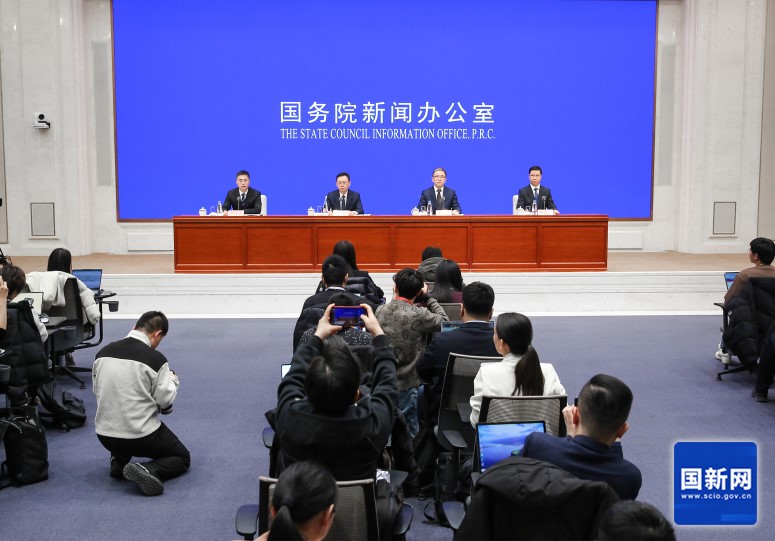
In January, the State Council Information Office held a press conference as part of the “China's High-Quality Economic Development Achievements” series, highlighting the progress of central enterprises in fostering high-quality growth.
The conference emphasized that central enterprises are pursuing a dual-side approach—stabilizing growth through proactive advancements and empowering traditional industries with emerging technologies. The “AI+” special action has been fully implemented, leading to the release of general-purpose AI models such as “Jiutian” and “Xingchen”, along with several industry-specific large models. AI applications have been deployed across 12 key industries, including healthcare, construction, and metallurgy, with over 400 specific use cases. Additionally, digitalization and green transformation efforts have accelerated, with 120 smart factories built throughout the year and China’s first million-ton hydrogen-based shaft furnace achieving continuous full-load operation, injecting new momentum into traditional industries.
The scale of strategic emerging industries within central enterprises has also expanded significantly. The 5G-A network has been fully commercialized, now covering over 300 cities nationwide, while new energy power installations account for 53% of the country’s total capacity. Moreover, a series of cutting-edge, industry-leading products have been introduced, including the world’s first 1,000-ton new energy bridge-building machine, which has been successfully put into operation.
Major projects and key projects continue to serve as powerful engines and solid foundations, fostering mutually beneficial cooperation and integrated development across enterprises of all ownership types. SASAC has launched the “Top 100 Projects” special action for strategic emerging industries within central enterprises. The first batch includes 137 projects covering key segments across nine industries. Throughout the year, 19 specialized industry chain collaboration events were organized, and more than 4,600 supply-demand matchmaking items were publicly released to enhance industrial synergy.
Looking ahead, SASAC will further refine and upgrade central enterprises’ strategic emerging industries by shaping new competitive advantages in high-quality development according to local conditions: focusing on optimizing the layout, guiding central enterprises to actively participate in the “Two Heavy, Two New” construction, and vigorously cultivating and developing new industries and future industries, accelerating the transformation and upgrading of traditional industries, and leading the development of new track and new industry integration clusters;
focus on increasing investment, strengthen forward-looking planning and policy guidance, directing incremental capital toward strategic emerging industries to support their expansion;
focusing on policy support, implementing long-cycle assessment, continuing to optimize support measures in R&D and innovation, talent development, production and and supply-demand coordination, supporting enterprises to dare to break through in new industries, and making greater contribution to shaping new energy for economic development and building new pillar industries.
Editor's Choice


Get the latest updates with our newsletter
Follow us
-

CCPA Wechat
-

CCPA EXPO Wechat
