




First Vertical Large Model for the Construction Industry Integrated into DeepSeek
Dr. Zhang Yingnan, Deputy Director of the Engineering Research Institute and Head of the AI Research Lab at Shanghai Construction No. 4 (Group) Co., Ltd., along with his team, is spearheading technological innovations to shift the industry from “manual labor-driven” approaches to “intelligent, AI-powered” solutions.
Traditionally, the construction industry has been synonymous with labor-intensive operations. However, with the increasing penetration of artificial intelligence (AI), the industry is undergoing a quiet yet profound transformation. Dr. Zhang Yingnan, Deputy Director of the Engineering Research Institute and Head of the AI Research Lab at Shanghai Construction No. 4 (Group) Co., Ltd., along with his team, is spearheading technological innovations to shift the industry from “manual labor-driven” approaches to “intelligent, AI-powered” solutions.
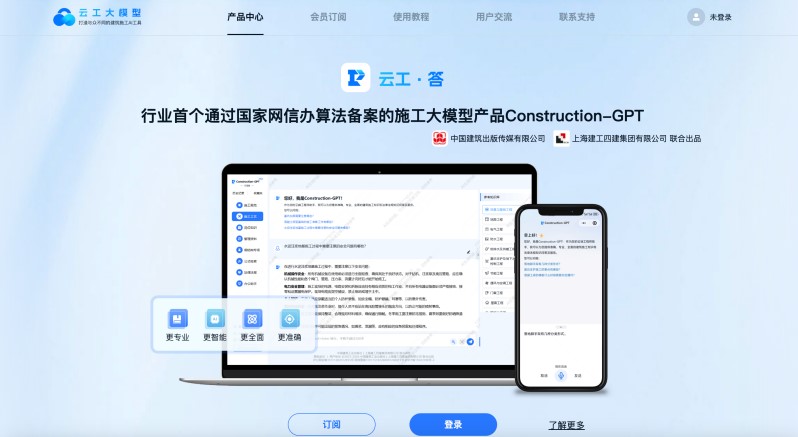
Dr. Zhang introduced that the team was established in 2021 and is one of the early groups in the construction industry focused on AI research and development. The core goal is to address efficiency challenges in construction through AI technology and drive productivity upgrades in the industry.
"The construction industry generates vast amounts of data, but the quality is often questionable," Dr. Zhang admitted, highlighting the team’s biggest challenge in the early stages. Although the construction industry has a large volume of historical data, it suffers from low data usability due to traditional, inefficient management practices. To tackle this issue, Shanghai Construction No. 4 (Group) Co., Ltd., in collaboration with China Architecture & Building Press, leveraged authoritative industry standards, professional books, and resources from the company’s own construction plans and blueprints. They independently developed Construction-GPT, the first vertical large model for the construction industry. This model is also the first in the industry to be officially registered with the Provisions on the Administration of Deep Synthesis of Internet-based Information Services, marking a significant milestone in the industry’s AI development.
Additionally, the team independently developed China’s first AI-powered MaaS system and product service platform for the construction industry, called “Cloud Engineer” (official website: https://cloudengineer.shjzgj.com). This platform is now fully open to market users, marking a breakthrough by turning the AI product order volume from “zero” into a tangible achievement.
The model focuses on frontline applications in construction projects and features eight major “Cloud Engineer” series products: Q&A, Construction Calculation, Construction Drawing, Construction Plan, Construction Monitoring, Ratio Analysis, Damage Monitoring, and Material Counting. The series was officially launched on September 12 last year and is designed for both enterprise and individual users. As of now, the platform has 50,000 registered users, with over 10 million total uses, and an impressive user retention rate of 96.8%.
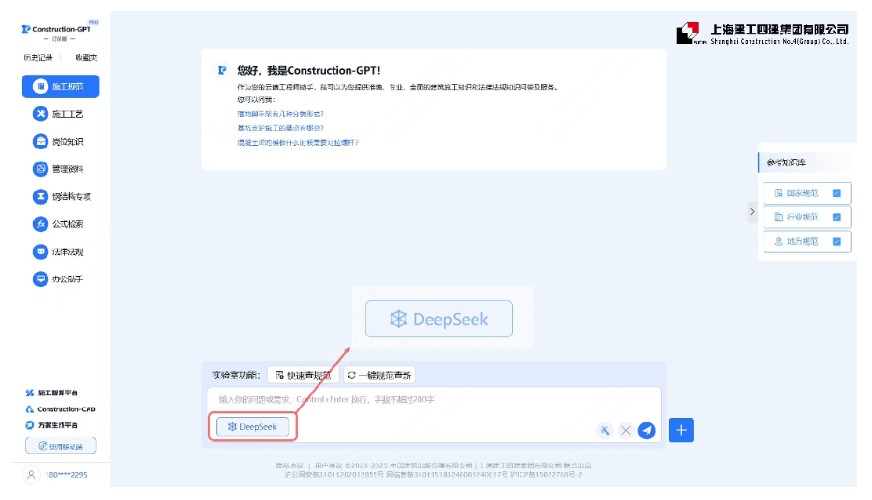
Regarding the recently popular DeepSeek open-source large model, Dr. Zhang believes its core value lies in its “reasoning capabilities” and the “open-source ecosystem.” Currently, the team has integrated DeepSeek into Construction-GPT, combining it with five specialized large model technologies developed by the team, including architecture-specific word embeddings, lightweight GPTQ model training, hybrid parent-child enhanced retrieval, hybrid expert system collaborative reasoning, low-rank fine-tuning, and building-specific model distillation. This integration is expected to significantly enhance the model’s performance in areas such as logic, comprehensiveness, accuracy, compliance, and professionalism, further optimizing its ability to serve the construction industry’s needs.
“In the past, large models could only summarize answers; now, they can explain the thought process.” For example, when asked about the “welding process specifications,” the model not only lists the key points but also analyzes the applicability in different scenarios. This ability is particularly crucial in complex engineering decision-making, as it allows for deeper insights and more informed choices based on context.
In the field of multimodal large model research, DeepSeek’s deep reasoning capabilities have provided researchers with new ideas. Traditional technologies for generating images and videos from text require large amounts of training data, whereas DeepSeek’s pure reinforcement learning technology could reduce dependence on large datasets, thus lowering the data processing workload and cost. Moreover, the open-source nature of DeepSeek significantly reduces research and development costs.
Dr. Zhang drew a comparison: “In the past, top models like OpenAI’s were closed-source, making them inaccessible for ordinary companies to use or modify. Now, with DeepSeek open-sourcing its technology, it’s like making the ‘engine’ blueprints public, allowing us and other developers to freely use and improve upon them.” This shift has directly reduced time costs, as companies no longer need to spend substantial time evaluating the performance of different model bases. “Now, it's widely accepted in the industry that DeepSeek has become one of the key choices for domestic open-source models. We can more efficiently filter and fine-tune models, alleviating the pressure caused by high computing costs to some extent.” Additionally, DeepSeek’s open-source model is expected to stimulate industry ecology. “Recently, more open-source large models have been released, providing us with more ‘engine’ options for future research and development,” Dr. Zhang added.
For future R&D planning, Dr. Zhang revealed two major directions:
1. Embodied Intelligence: Enabling Autonomous Construction by Robots
To tackle the shortage of construction workers, the company plans to develop AI-powered construction robots. Traditional robots are primarily automated devices that rely on pre-programmed instructions and lack adaptive capabilities. However, by integrating DeepSeek’s reasoning abilities, these robots will be able to autonomously assess and respond to complex situations. For instance, a spraying robot could adjust its technique based on real-time site conditions, while a transport robot could navigate around dynamic obstacles autonomously. “This goes beyond mere automation—this is true intelligence, paving the way for full autonomy,” Zhang explained. Furthermore, construction robots offer significant safety advantages. With 360-degree perception capabilities, they can enhance on-site safety, reducing risks for workers and freeing humans from hazardous and repetitive tasks.
2. Upgrading from “Tool” to “Productivity Platform”
Currently, AI primarily enhances individual efficiency, but the next goal is to empower enterprise-wide management and full-cycle project oversight, including cost control, progress tracking, and safety management. “In the future, AI will not only be an assistant for technicians but also serve as the ‘intelligent brain’ for corporate management and project leaders,” Zhang noted.
As algorithms start ‘laying bricks’ and models learn to ‘read blueprints,’ this silent revolution may fundamentally redefine the meaning of “labor-intensive” in the construction industry.


Get the latest updates with our newsletter
Follow us
-

CCPA Wechat
-

CCPA EXPO Wechat
