




National Bureau of Statistics: 2024 Construction Industry Value Added Reaches 8.99 trillion Yuan!
 Printing
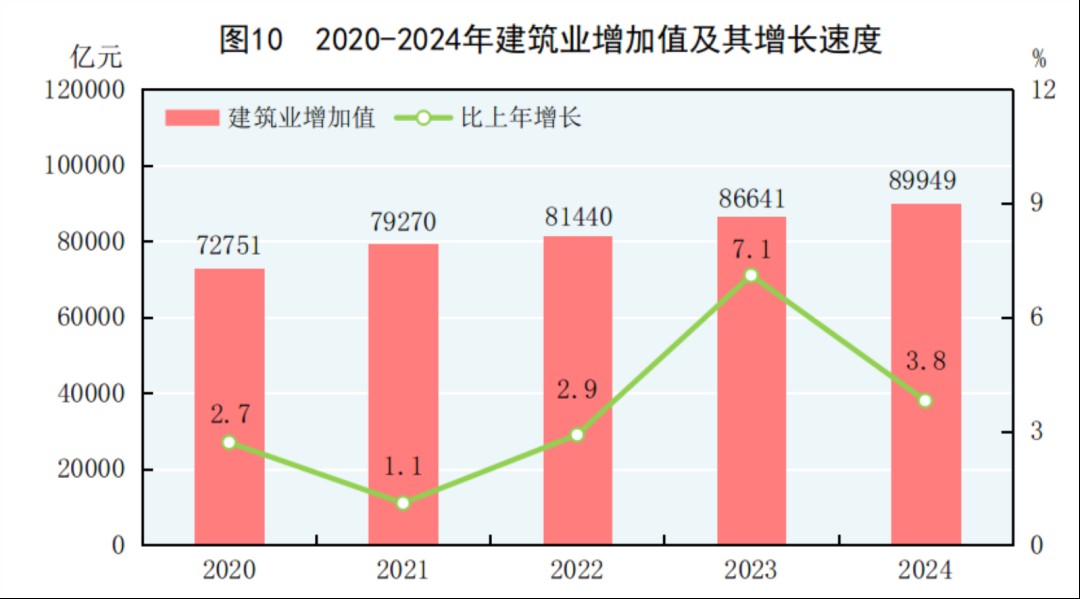
Recently, the National Bureau of Statistics (NBS) released the 2024 Statistical Communiqué on National Economic and Social Development. The report highlights that the total value added of the construction industry in 2024 amounted to 8.99 trillion yuan, marking a 3.8% year-on-year increase.
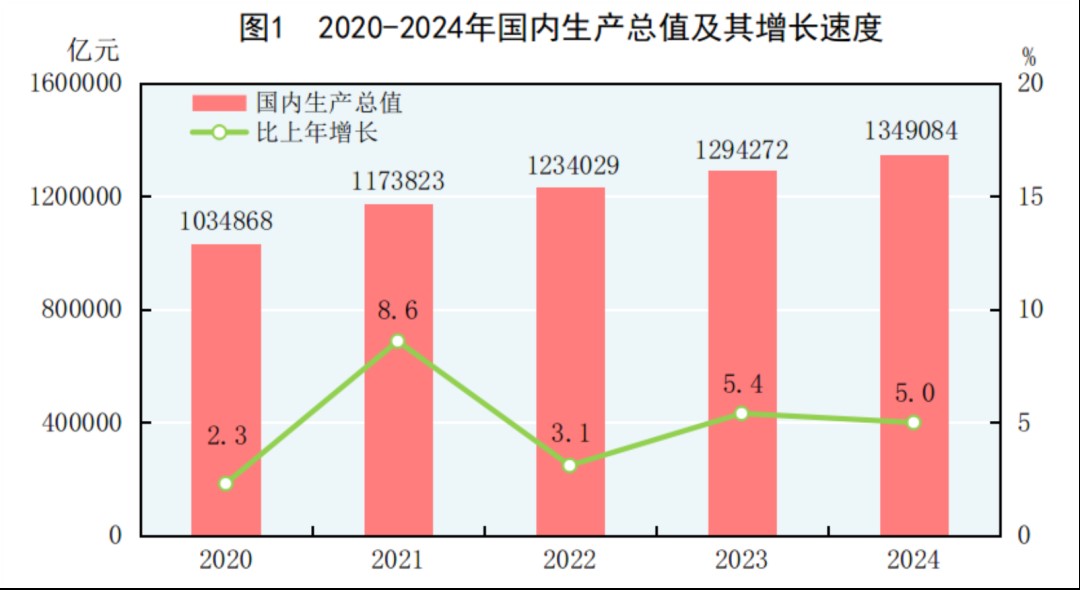
Recently, the National Bureau of Statistics (NBS) released the 2024 Statistical Communiqué on National Economic and Social Development. According to preliminary calculations, China’s Gross Domestic Product (GDP) for the year reached 134.91 trillion yuan, reflecting a 5.0% growth compared to the previous year. The report also highlights that the total value added of the construction industry in 2024 amounted to 8.99 trillion yuan, marking a 3.8% year-on-year increase.
Overview of China’s National Economy and Social Development in 2024
According to preliminary calculations, China’s GDP for 2024 reached 134.91 trillion yuan, reflecting a 5.0% year-on-year growth. The GDP growth rates by quarter were as follows: Q1: 5.3%; Q2: 4.7%; Q3: 4.6%; Q4: 5.4%. The per capita GDP stood at 95,749 yuan, an increase of 5.1% from the previous year. Gross National Income (GNI) reached 133.97 trillion yuan, up 5.1%. Labor productivity improved, with output per worker reaching 173,898 yuan, reflecting a 4.9% increase.
Steady progress was made in urban-rural integration and regional coordination. By region, the GDP of the eastern region reached 70.24 trillion yuan, up 5.0% from the previous year; the central region recorded 28.72 trillion yuan, up 5.0%; the western region posted 28.74 trillion yuan, up 5.2%; and the northeastern region totaled 6.35 trillion yuan, up 4.4%. The GDP of the Beijing-Tianjin-Hebei region stood at 11.54 trillion yuan, up 5.2%; the Yangtze River Economic Belt reached 63.02 trillion yuan, up 5.4%; and the Yangtze River Delta region reached 33.17 trillion yuan, up 5.5%. Major regional development strategies, such as the Guangdong-Hong Kong-Macao Greater Bay Area development and ecological protection and high-quality development of the Yellow River Basin, have yielded positive results.
The green low-carbon transition continues to deepen. Based on preliminary calculations, the nation’s carbon dioxide emissions per unit of GDP decreased by 3.4% from the previous year,. The total clean energy power generation (including hydropower, nuclear power, wind power, and solar power) amounted to 3.71 trillion kWh, up 16.4% year-on-year. Among 339 monitored cities at or above the prefecture level, 65.5% met air quality standards, while 34.5% did not. Of the 3,641 national surface water assessment sections, 90.4% were classified as Grade I-III water quality (excellent), 7.8% as Grade IV, 1.2% as Grade V, and 0.6% as below Grade V (heavily polluted).
2024 Construction Industry Data
The construction industry’s total added value for the year reached 8.99 trillion yuan, reflecting a 3.8% year-on-year increase. The total profit of general contracting and specialized contracting construction enterprises with qualification grades amounted to 751.3 billion yuan, a decrease of 9.8%. Among them, state-controlled enterprises recorded a profit of 366.9 billion yuan, down 8.7%.
2024 Fixed Asset Investment
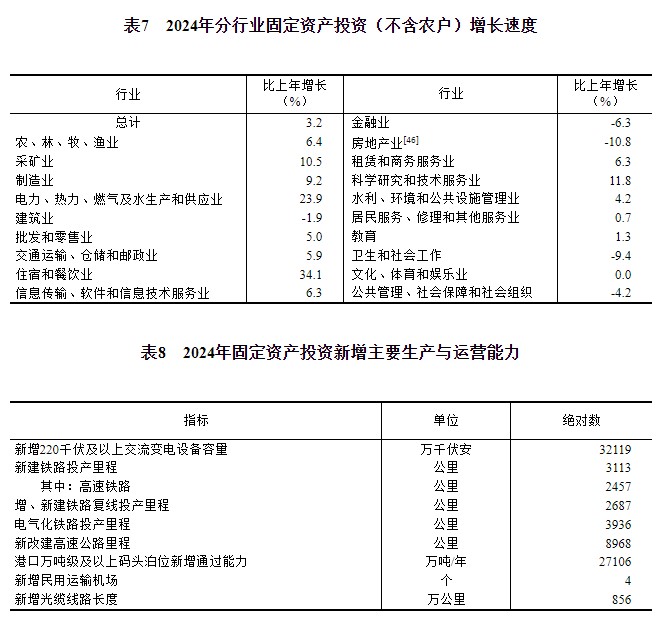
The total fixed asset investment for 2024 amounted to 52.09 trillion yuan, an increase of 3.1% over the previous year. Fixed asset investment (excluding rural households) stood at 51.44 trillion yuan, up 3.2%, with investment in equipment and tools growing by 15.7%. By region, fixed asset investment (excluding rural households) grew by 1.3% in the eastern region, 5.0% in the central region, 2.4% in the western region, and 4.2% in the northeastern region.
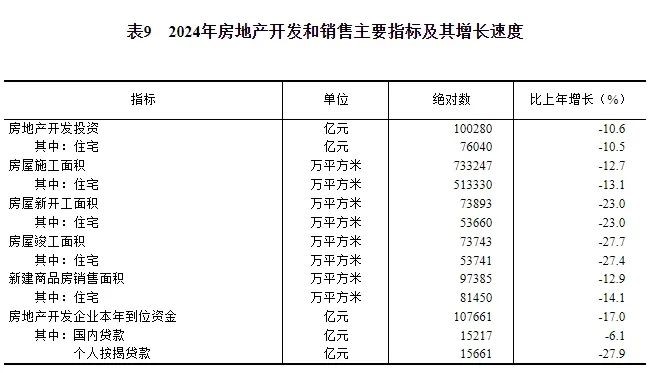
Total real estate development investment reached 10.03 trillion yuan, down 10.6% from the previous year. Among this, residential investment amounted to 7.60 trillion yuan, down 10.5%; office building investment was 416 billion yuan, down 9.0%; commercial business property investment totaled 694.4 billion yuan, down 13.9%. The total newly built commercial housing sales area for the year reached 973.85 million square meters.
For the year as a whole, 1.8 million units of subsidized housing, subsidized rental housing and public rental housing were constructed and mobilized; 1.89 million units of resettlement housing for the transformation of urban villages were constructed and mobilized, and 79,000 units of old and dilapidated urban housing were transformed; 58,000 old urban residential communities were upgraded, benefiting 9.66 million households; and239,000 rural low-income households and key groups had their dilapidated homes renovated or earthquake-proofed.
Editor's Choice


Get the latest updates with our newsletter
Follow us
-

CCPA Wechat
-

CCPA EXPO Wechat
