




Cement That Can Both Generate and Store Electricity Debuts in China
On May 9, a research team led by Miao Changwen, academician of the Chinese Academy of Engineering and professor at Southeast University, announced the development of the world’s first bioinspired self-powering and energy-storing concrete.
Cement that can generate electricity—and store it? On May 9, a research team led by Miao Changwen, academician of the Chinese Academy of Engineering and professor at Southeast University, announced the development of the world’s first bioinspired self-powering and energy-storing concrete.
In this breakthrough, the team developed two types of self-generating cement-based metamaterials: N-type thermoelectric cement and P-type thermoelectric cement. “These two cement-based metamaterials are primarily composed of cement. Through a special process, we added organic materials such as polyvinyl alcohol (PVA) to construct a cement-based composite with a ‘soft–hard’ alternating, orderly layered microstructure similar to the root-stem tissues of plants,” said Professor Zhou Yang of Southeast University, a researcher on the team. This microstructure enhances the toughness of the cement by nearly tenfold while also facilitating more efficient ionic conduction within the material.
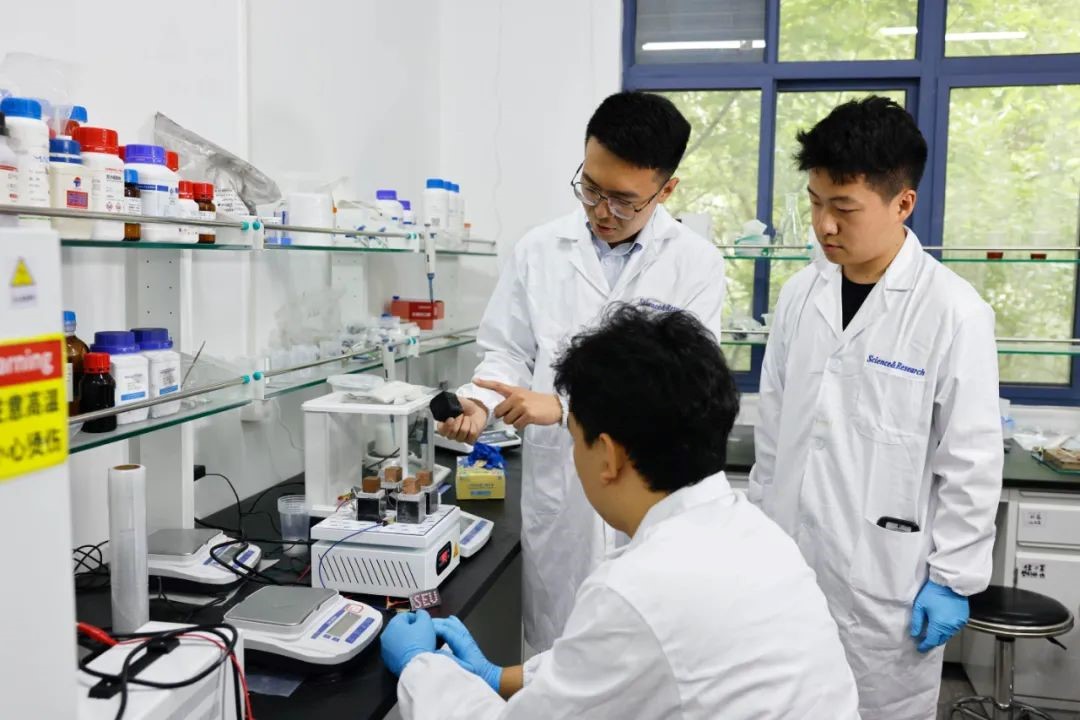
According to Zhou, the interface formed between the cement and PVA exhibits ion selectivity. Calcium ions in the cement tend to be trapped at the interface, while hydroxide ions can pass through more freely, creating a potential difference between the upper and lower surfaces of the cement layer. When a temperature gradient is applied to the cement surface, it induces a difference in the ion transport rate across the material. The larger the difference, the greater the resulting voltage—thus enabling power generation.
The team also developed a self-charging cement-based supercapacitor. “This supercapacitor has a sandwich-like structure,” Zhou explained, “The cement electrodes on both sides can store active substances and adsorb ions, while the middle cement-based electrolyte layer conducts ions. The ordered layered microstructure in the electrolyte allows for fast ion transport while blocking electrons, thereby enabling the storage of electrons in the cement electrodes—essentially forming a ‘power reservoir.’” The self-charging cement-based supercapacitor maintains the high strength of traditional cement while increasing ionic conductivity by six orders of magnitude. It offers excellent electrochemical reversibility and rapid charge transfer capabilities. Even after 20,000 charge-discharge cycles, the device retains 95% of its initial specific capacitance—making it capable of lasting as long as the buildings in which it is used.


Get the latest updates with our newsletter
Follow us
-

CCPA Wechat
-

CCPA EXPO Wechat
