




[Concrete Science and Technology Award] Retrospective on Award-Winning Achievements (Part 3)
[Concrete Science and Technology Award] Retrospective on Award-Winning Achievements (Part 3)
First Prize in Basic Theoretical Research – 2023
Project Title: Key Theoretical Research on the Application of Steel Slag Powder in Concrete
Completed by: Tsinghua University
Project Overview:
Achieving carbon peaking and carbon neutrality is a major strategic goal for China's development. Steel slag, a byproduct of the steelmaking process, is a large-volume industrial waste. Utilizing it as a mineral admixture in concrete is a crucial path for recycling steel slag and an effective approach to developing low-carbon cement. However, the application of steel slag in concrete faces several critical scientific and technical challenges, which severely limit its safe, scientific, and efficient use.
This project focuses on five major scientific and technological issues that restrict the use of steel slag in concrete: low reactivity; abnormal setting behavior; poor stability; key technologies for producing high-dosage steel slag concrete, and synergistic utilization with other solid wastes. Following a research path from theory to application, from phenomena to mechanisms, and from the microscopic to the macroscopic, the team conducted systematic and in-depth studies.
Major scientific findings include:
Unveiled the hydration mechanism of steel slag, innovated evaluation methods for its reactivity, and proposed scientific approaches to enhance reactivity.
Proposed the reaction mechanism of cement–steel slag composite binders, revealing how steel slag affects cement hydration and setting behavior.
Clarified the reaction mechanisms of free lime (f-CaO) and periclase (MgO) under different conditions and their impact on the volume stability of steel slag.
Investigated how steel slag affects the workability, mechanical properties, durability, and microstructure of concrete under equal water-binder ratio and equivalent 28-day strength conditions, and developed key technologies for high-volume steel slag concrete.
Clarified the roles and interactions of cement, slag, and steel slag in multi-component cementitious systems, and developed synergistic utilization technologies for steel slag with other solid wastes.
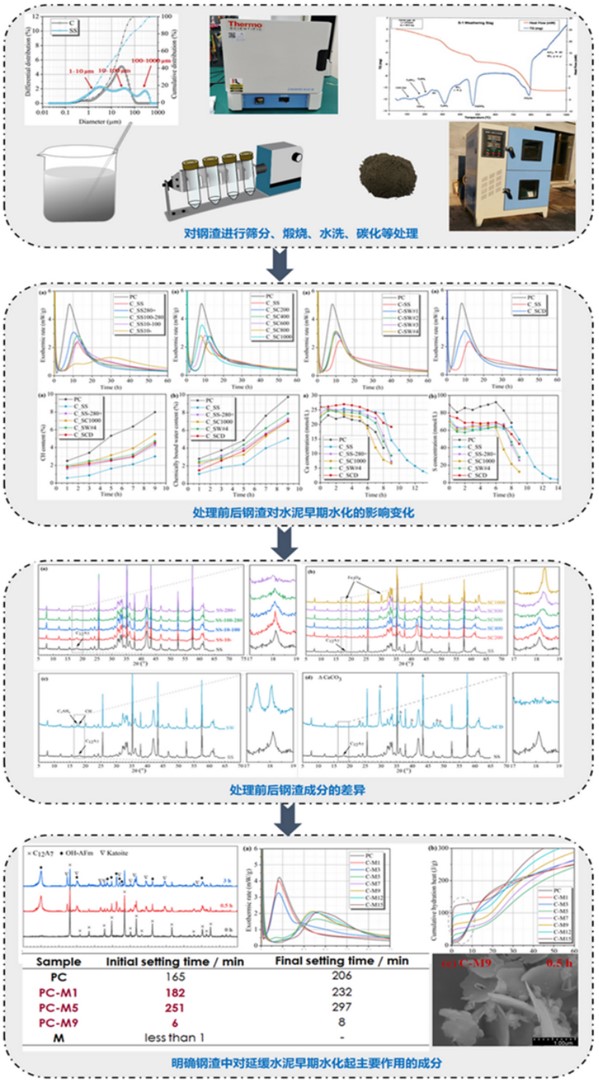
Main Mineral Phases in Steel Slag Affecting Cement Hydration and Their Mechanisms of Action
Second Prize in Basic Theoretical Research – 2020
Project Title: Design and Performance Regulation of Ultra-High Performance Fiber-Reinforced Concrete Based on Dense Particle Packing Theory
Completed by: Wuhan University of Technology
Project Overview:
In Ultra-High Performance Concrete (UHPC) systems, achieving the densest possible internal packing is fundamental to ensuring superior performance. However, current UHPC design lacks systematic guidance based on dense particle packing theory. Inadequate design of fiber dosage, water content, and superplasticizer often leads to poor homogeneity, insufficient density, low fiber efficiency, high energy consumption, and high cost.
This project applied the theory of dense particle packing to the design of ultra-high performance fiber-reinforced concrete (UHPFRC), and achieved a series of theoretical innovations in areas such as UHPC mix optimization, durability enhancement, fiber orientation control, micromechanical parameter regulation, and volumetric stability.
Key scientific contributions include:
Developed a close-packing system for UHPC materials and proposed an optimized design method by incorporating steel fibers into the system via equivalent diameter modeling.
Introduced solid waste materials such as recycled aggregates and tailings to partially replace cementitious components, establishing an ecological UHPC design framework.
Proposed optimized casting methods for UHPC based on slurry rheology and wall effect theory, identified operational parameters for better fiber orientation and distribution, and modeled fiber movement during casting.
Investigated mechanisms for regulating volumetric stability, considering the synergistic effects of supplementary cementitious materials and expansive agents on self-compacting UHPC.
Identified optimal fiber parameters for UHPC in harsh environments and evaluated their influence on electrochemical corrosion resistance.
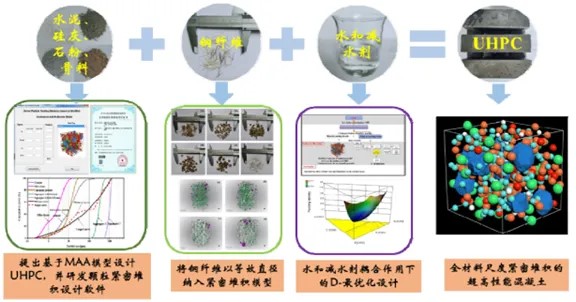
Multi-Scale Dense Particle Packing Design Theory for UHPC
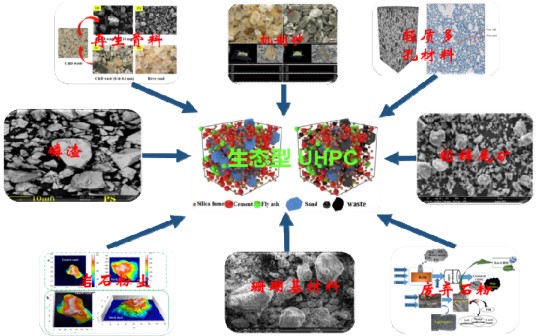
Ecological UHPC Design Framework
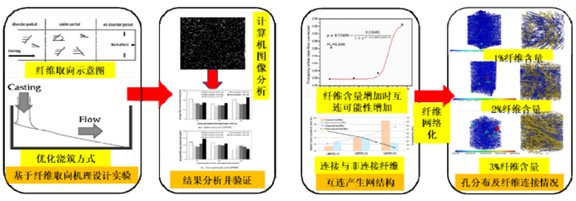
Fiber Dynamics Model and Overlap Mechanism in UHPC


Get the latest updates with our newsletter
Follow us
-

CCPA Wechat
-

CCPA EXPO Wechat
