




Main Tower of Tuojiang River Bridge on Chengdu East–West City Axis Successfully Topped Out
The main tower of the Tuojiang River Bridge on Chengdu’s East–West City Axis, Sichuan Province, has been successfully and precisely topped out. This milestone marks a critical step forward, laying a solid foundation for the bridge’s subsequent construction and full completion.
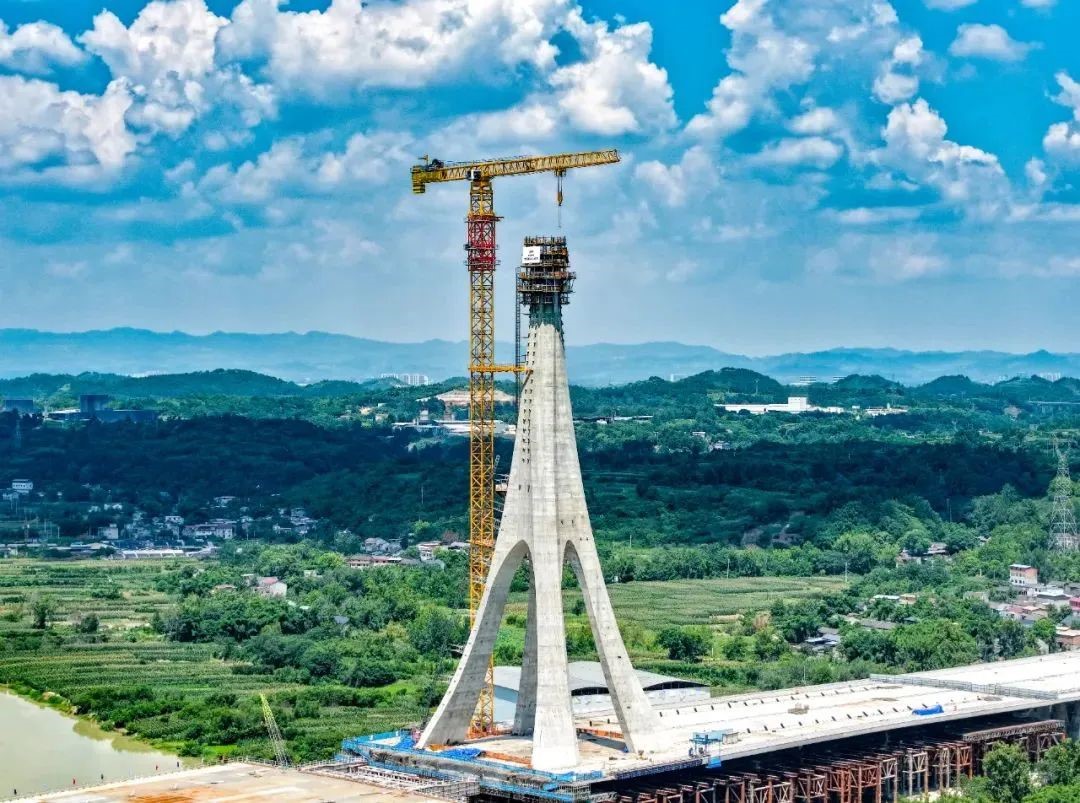
On-site construction photo
The Chengdu East–West City Axis is a backbone project of the transportation network under the “Chengdu–Chongqing Twin-City Economic Circle” initiative, and is hailed as the east–west counterpart of “Tianfu Avenue”. The Tuojiang River Bridge, a landmark project along this axis, is located between Duba Community in Shiqiao Subdistrict and Liulin Community in Shehongba Subdistrict of Jianyang. The bridge is designed as a spatially irregular single-pylon, double-cable-plane, asymmetrical composite girder cable-stayed bridge. It is developed and managed by Chengdu City Construction Investment & Management Group Co., Ltd. and built by China Railway Construction Bridge Engineering Bureau Group Co., Ltd. The bridge has a total length of 1,010 m, including a 455-meter-long main span, a 525-meter-long north approach bridge, and a 30-meter-long south approach bridge. The deck reaches a maximum width of 79 m. Its main tower rises to 159 m, equivalent to the height of a 50-story building.
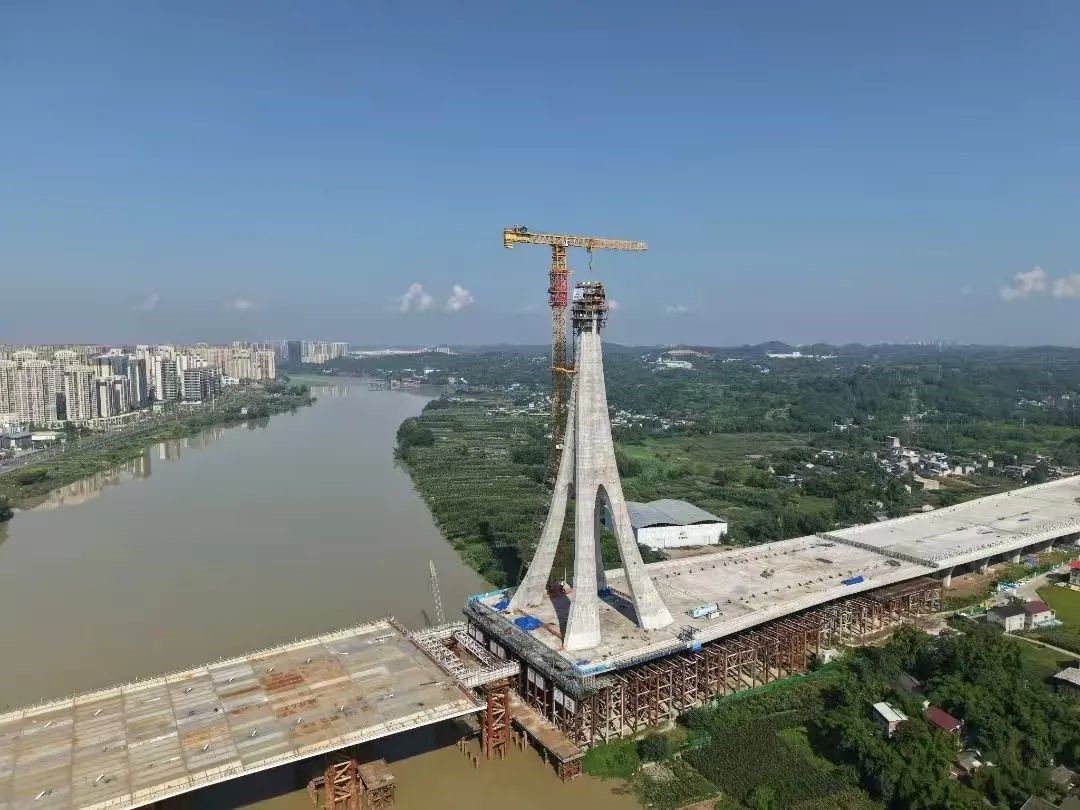
On-site construction photo
The main tower features a spatial “flower-bud” design, which posed multiple engineering challenges. These included handling the asymmetrical polygonal cross-section that transitions in width from 14.25 m to 6.4 m; achieving millimeter-level alignment accuracy at 150 m above ground, often described as “embroidery in the sky”; and managing the curvature variations of the side cross-sections at such heights, with template installation tolerances controlled within millimeters.
The project team applied 3D printing topology optimization technology to experimental models of the spatial irregular tower column and verified the feasibility of the cross-section tapering scheme through physical printed models. At the same time, the integrated “BIM + Digital Twin” system, supported by sensors installed on the tower columns, enabled real-time deformation monitoring.
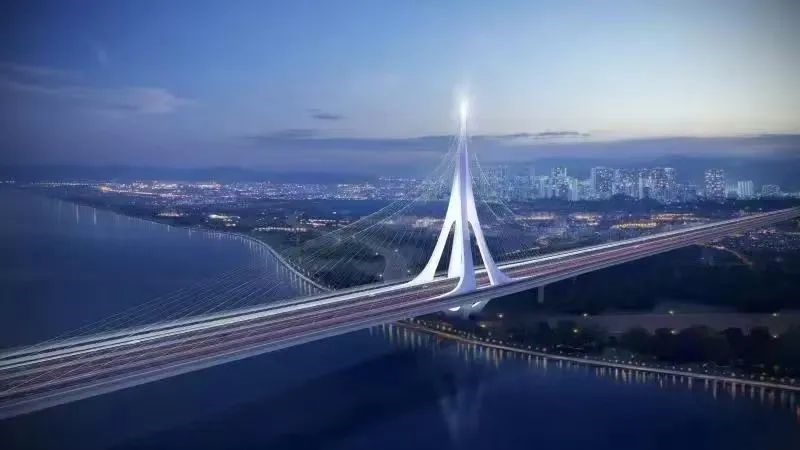
Rendering of the project
In addition, the construction encountered unprecedented technical challenges, including an ultra-wide bridge deck, ultra-high tensile forces in stay cables, and the complex geometry of the tower column, with no domestic precedents to follow. To address these, a dedicated research group on key construction technologies for ultra-wide spatial single-tower hybrid girder cable-stayed bridges was established. Together with expert teams, the project explored technical “no-man’s land,” overcoming major difficulties in bridge engineering.
Notably, in the structural system, to achieve asymmetrical mechanical balance for 38 pairs of reversed stay cables lone towers, a spatial cable arrangement was designed, forming a cable-stayed system in which a single cable can bear a maximum load of 1,513 tons—equivalent to lifting 1,000 passenger cars at once. Furthermore, the tower–girder consolidation segment used ultra-high-performance RPC concrete with a total volume of 6,500 m3, setting a record for civil engineering applications.
The Chengdu East–West City Axis is an integral part of the “one core, two wings, three axes, and multiple centers” networked spatial structure outlined in Chengdu’s new master plan. Upon completion, the project will significantly strengthen the Chengdu–Chongqing Twin-City Economic Circle, advance the integrated development of Chengdu and Ziyang, and serve as a vital artery driving regional urban connectivity.


Get the latest updates with our newsletter
Follow us
-

CCPA Wechat
-

CCPA EXPO Wechat
