




 Printing
Recently, the Huajiang Canyon Bridge in Guizhou Province—jointly invested and constructed by China Gezhouba Group Co., Ltd. and China Gezhouba Group Road & Bridge Co., Ltd.—was officially opened to traffic.
Recently, the Huajiang Canyon Bridge in Guizhou Province—jointly invested and constructed by China Gezhouba Group Co., Ltd. and China Gezhouba Group Road & Bridge Co., Ltd.—was officially opened to traffic. As the world’s highest bridge and the longest-span bridge in mountainous terrain, it once again demonstrates to the world the ingenuity and strength of China’s bridge engineering.
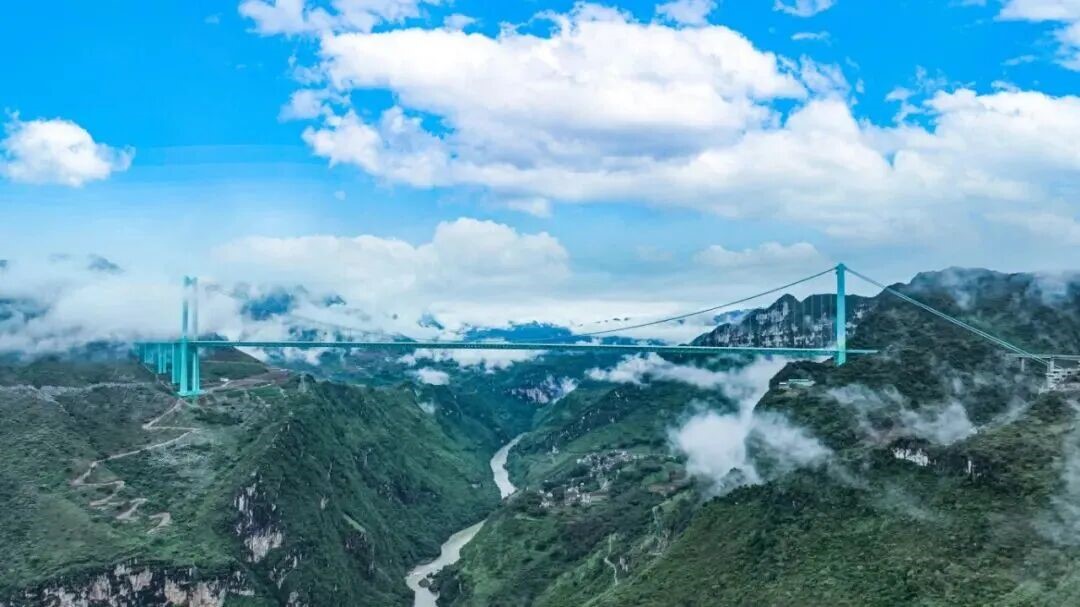
As a key control project of the Liuzhi–Anlong Expressway, the Huajiang Canyon Bridge stretches 2,890 m in total length, with the deck towering 625 m above the river, about 60 m higher than the Beipanjiang No. 1 Bridge. The main span measures 1,420 m. Facing formidable world-class challenges such as the complex geological conditions of the Huajiang Grand Canyon, instantaneous winds reaching up to Level 14, and high-precision operations at an altitude exceeding 600 m, the project team adopted a series of innovative engineering solutions.
The bridge employs a streamlined steel truss girder combined with a central stabilizing plate, forming a high-performance aerodynamic resistance system. The steel truss features a waterdrop-shaped cross-section, effectively reducing wind load by 30%, while the 2-meter-high central stabilizing plate dissipates up to 90% of lateral wind-induced vibration, ensuring overall structural safety. The project also utilizes Doppler laser radar for all-weather wind field monitoring, providing precise data support for both construction and operation. Cutting-edge technologies such as an intelligent cable crane system and 2,000 MPa ultra-high-strength steel wires were adopted, with several technological achievements later incorporated into national bridge construction standards. These innovations elevate China’s design and construction capabilities to new heights and offer a “Chinese solution” for large-span bridge construction in mountainous regions worldwide.
With the bridge now open, the Liuzhi–Anlong Expressway is fully operational, linking major national highways such as Duyun-Shangrila, Shanghai-Kunming, and Shantou-Kunming Expressways. The opening reduces the travel time between Zhenfeng County and Guanling County, which once required a two-hour detour around the canyon, to just two minutes. The completion of the Huajiang Canyon Bridge significantly improves regional transportation connectivity, optimizes the regional highway network, and facilitates resource sharing and circulation between neighboring areas. It will also stimulate the growth of tourism, leisure agriculture, and specialty industries along the route, thus promoting high-quality economic and social development and advancing the implementation of China’s rural revitalization strategy.
Editor's Choice


Get the latest updates with our newsletter
Follow us
-

CCPA Wechat
-

CCPA EXPO Wechat
