




Dual-Core Intelligent Control Technology Solves the Challenge of Casting Rigid Waterproof Concrete
Recently, the China Railway Sixth Bureau Beijing Company Shenyang Project Department successfully developed and applied an integrated technological solution combining material innovation, intelligent temperature control, and precision construction.
Recently, the China Railway Sixth Bureau Beijing Company Shenyang Project Department successfully developed and applied an integrated technological solution combining material innovation, intelligent temperature control, and precision construction. This new approach effectively addressed long-standing issues such as concentrated heat release from cement hydration and insufficient waterproofing performance, providing strong technical assurance for the high-quality construction of Shenyang Hunnan Science and Technology City.
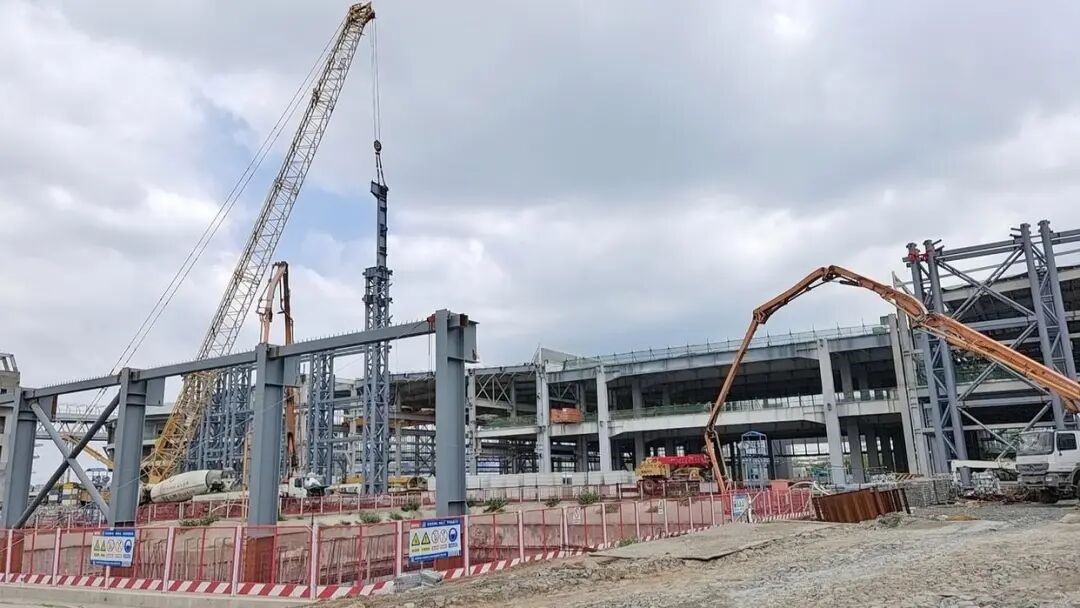
The M15 plot deep foundation project for large-scale equipment — part of Phase VI of Shenyang Hunnan Science and Technology City and undertaken by the China Railway Sixth Bureau Beijing Company Shenyang Project Department — adopted an integral raft foundation design with a raft thickness of 3.9 m and a total volume of 3,085 m3. The structure belongs to the category of mass rigid waterproof concrete. Under traditional construction methods, such large-scale concrete pours often suffered from problems such as concentrated hydration heat release, inadequate waterproof performance, and insufficient temperature control precision — resulting in a cracking rate exceeding 95%.
To overcome these difficulties, the project team established a specialized task force of core technical experts to tackle the problem from two dimensions: material innovation and construction technology. In terms of material innovation, the team optimized the concrete mix and introduced a hydration-heat-suppressing waterproof admixture with dual key functions. On one hand, it enables intelligent thermal regulation — effectively moderating internal temperature variations, delaying the hydration heat peak, and significantly reducing adiabatic temperature rise, thereby eliminating the risk of cracking caused by excessive internal-external temperature differentials. On the other hand, it possesses a self-healing capability: when microcracks occur, crystals automatically form to seal the gaps, ensuring both structural integrity and the designed waterproofing grade — creating a durable protective barrier for the equipment foundation.
From the construction technology perspective, an innovative “internal cooling and external insulation + real-time temperature monitoring” closed-loop control system was implemented. Cooling water pipes were embedded inside the concrete, allowing continuous water circulation for efficient heat dissipation. Precision sensors captured real-time temperature data from both internal and external zones to maintain a safe temperature differential.
Meanwhile, a scientific layered casting method was employed to precisely control layer thickness and casting rhythm, ensuring seamless integration between new and previously placed concrete. Vibration operations focused on areas with dense embedded parts, ensuring uniformity and density throughout — comprehensively improving both construction quality and efficiency.
Guided by this innovative technical solution, the project department successfully completed the continuous concrete pouring in over 30 hours this July. The final structure exhibited no cracking, while waterproof performance and compactness both met design standards. This achievement not only laid a solid foundation for subsequent equipment installation and project progress but also showcased the team’s strong technical capabilities in complex structural construction.


Get the latest updates with our newsletter
Follow us
-

CCPA Wechat
-

CCPA EXPO Wechat
