




New Progress in the Construction of the Shituo Yangtze River Bridge
 Printing
Recently, the first steel girder section of the Shituo Yangtze River Bridge, undertaken by China RAILWAY MAJOR BRIDGE Engineering Group Co., Ltd.(MBEC), was successfully hoisted into position.
Recently, the first steel girder section of the Shituo Yangtze River Bridge, undertaken by China RAILWAY MAJOR BRIDGE Engineering Group Co., Ltd.(MBEC), was successfully hoisted into position. This marks the official commencement of the bridge’s hybrid girder construction stage, laying a solid foundation for the project’s timely completion and opening to traffic.
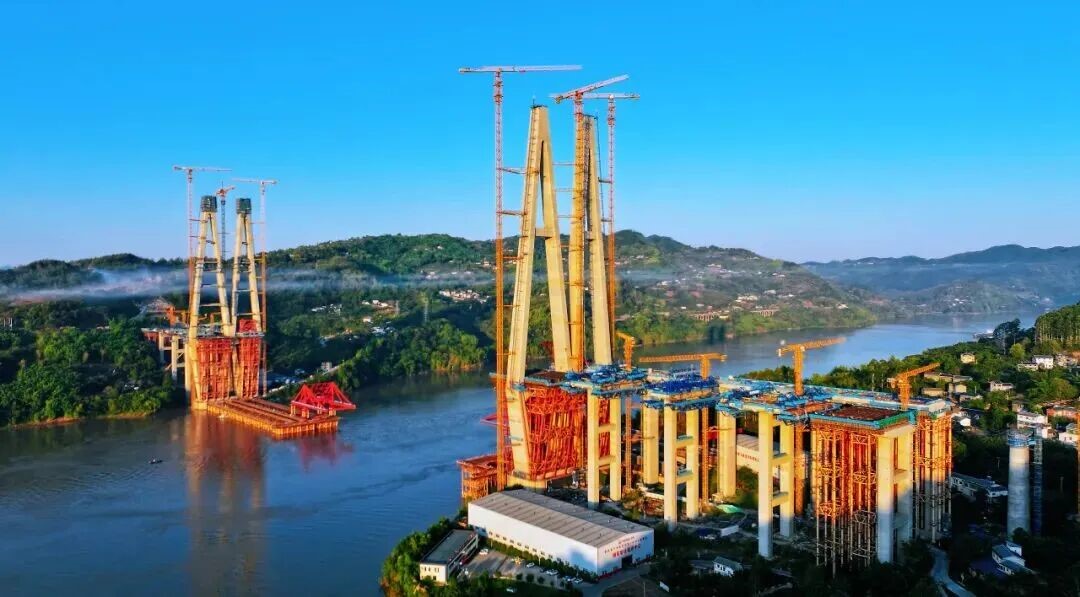
Located within the Zhongdui Channel in the upper reaches of the Yangtze River, the Shituo Yangtze River Bridge has a total mainline length of 1,416.9 m. As a key and controlling project of the Chongqing–Wanzhou High-Speed Railway, the bridge is characterized by its complex structural design and challenging construction organization. Upon completion, it will set four world records:
The world’s first double-tower bridge integrating both railway and highway decks;
The world’s first same-level separated-deck main girder for a combined road-rail bridge;
The world’s tallest double-tower bridge, with its No. 6 main tower reaching 253 m in height;
The world’s largest-span same-level hybrid girder cable-stayed bridge for a combined road-rail system, with a main span of 608 m.
The steel-concrete hybrid girder segment installed this time measures 9.625 m in length, 23.6 m in width, and 4.514 m in height, with a total weight of about 550 t — equivalent to the weight of approximately 310 passenger cars.
To ensure safe and precise installation, the project team adopted a “digital twin + intelligent monitoring” construction system. A total of 32 high-precision sensors were deployed during the 550-ton lifting process to collect 12 types of real-time data including stress and displacement. Through 5G transmission and dynamic linkage with a BIM model, data integration significantly enhanced construction efficiency and precision. After the steel girder arrived at the designated position by transport vessel, it was hoisted from the dock by a crane onto sliding supports, longitudinally moved into position, and combined with the bridge deck panel. The final vertical lift to the design elevation was completed by the deck-mounted hoisting crane.
The bridge site lies within the Three Gorges Reservoir region of the Yangtze River. The main towers are situated away from the main navigation channel, at the junction of land and water, where water level fluctuations are large, flow velocity is high during flood season, and seasonal changes in water level are significant. Due to the shallow-water sections, steel girder segments could not be directly shipped to the erection site. Therefore, the project team adopted an integrated “transport vessel + dock crane + sliding support + deck crane” transfer and erection scheme, achieving safe and efficient installation under complex hydrological and geographic conditions.
Upon the completion and opening of the Chongqing–Wanzhou High-Speed Railway, travel time between the two cities will be reduced to less than one hour, providing a strong boost to the Chengdu–Chongqing Twin-City Economic Circle and playing a vital role in advancing national strategies such as the Yangtze River Economic Belt.
Editor's Choice


Get the latest updates with our newsletter
Follow us
-

CCPA Wechat
-

CCPA EXPO Wechat
