




Launch of the World’s First 200-Meter Steel Concrete Hybrid Tower — Total Turbine Height Expected to Exceed 310 Meters
 Printing
Recently, CSSC Science & Technology Co., Ltd. unveiled its latest structural innovation — the world’s tallest 200-meter-class steel concrete hybrid tower, marking a major breakthrough in hybrid tower technology.
Recently, CSSC Science & Technology Co., Ltd. (hereinafter referred to CSSC) unveiled its latest structural innovation — the world’s tallest 200-meter-class steel concrete hybrid tower, marking a major breakthrough in hybrid tower technology. Tailored for regions characterized by low wind speeds and high wind shear, this flagship product not only sets a new record in tower height but also addresses one of the core technical challenges in wind power development under complex wind conditions, injecting new momentum into China’s pursuit of higher efficiency and better performance in the wind energy sector.
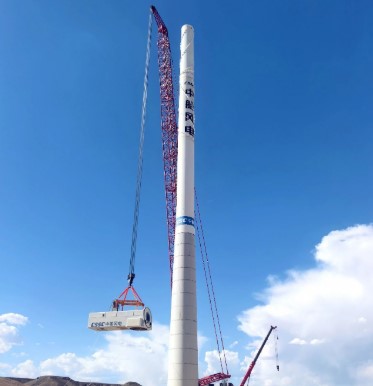
At present, mainstream hybrid towers in the wind power market typically range between 140 m and 160 m in height. However, as high-quality wind resources become increasingly scarce and turbine capacities continue to scale up, ultra-tall hybrid towers above 180 m have become essential for developing low-wind-speed regions. CSSC’s newly released 200-meter hybrid tower solution directly targets this critical market demand.
The company’s first 200-meter hybrid tower will be erected in the Gaoyang project in Baoding, Hebei Province during the first quarter of 2026. Once paired with the H220-6.25 MW wind turbine, the total turbine height will exceed 310 m, providing a robust structural solution for harnessing wind resources in low-wind-speed and high-wind-shear areas.
“For every 10-meter increase in hybrid tower height, the wind turbine can capture 5%–8% more wind energy — the performance gain at 200 m is remarkable,” said Li Tao, Product Manager of CSSC’s hybrid tower line. Taking the Gaoyang project as an example, increasing the hub height from 160 m to 200 m is expected to boost equivalent full-load hours by about 155 hours, raise the return on investment by approximately 0.5 percentage points, and increase annual revenue per turbine by over RMB 300,000.
The significance of this breakthrough extends far beyond individual project benefits. Based on detailed economic analysis, the 200-meter hybrid tower solution can enhance the development value of low-wind-speed regions by more than 30%, unlocking the vast wind resource potential in China’s central-eastern and southwestern regions, where millions of kilowatts of capacity had previously been considered uneconomical. “Many wind farms used to be left idle because low wind speeds made their investment returns fall below the investment threshold. The 200-meter hybrid tower is essentially the key that unlocks these ‘dormant resources,’” Li Tao explained. The successful implementation of this solution not only consolidates CSSC’s technological leadership in hybrid tower systems but also expands the geographical boundaries of wind power development — driving the industry’s transition from merely “competing for resources” to “creating resources.”
Editor's Choice


Get the latest updates with our newsletter
Follow us
-

CCPA Wechat
-

CCPA EXPO Wechat
