




Closure of the Crossing Chu River Cable-Stayed Bridge on the Nanjing Grand Bridge of the Shanghai-Nanjing-Hefei High-speed Railway
 Printing
On the evening of January 8, the crossing Chu River cable-stayed bridge, a key control project of the newly built Shanghai–Nanjing–Hefei high-speed railway, was successfully closed on the Nanjing Grand Bridge, achieving a precise mid span connection across a waterway spanning several hundred meters.
On the evening of January 8, the crossing Chu River cable-stayed bridge, a key control project of the newly built Shanghai–Nanjing–Hefei high-speed railway, was successfully closed on the Nanjing Grand Bridge, achieving a precise mid span connection across a waterway spanning several hundred meters. This marks the full completion of the main structure of the cable-stayed bridge and the transition to deck system works.
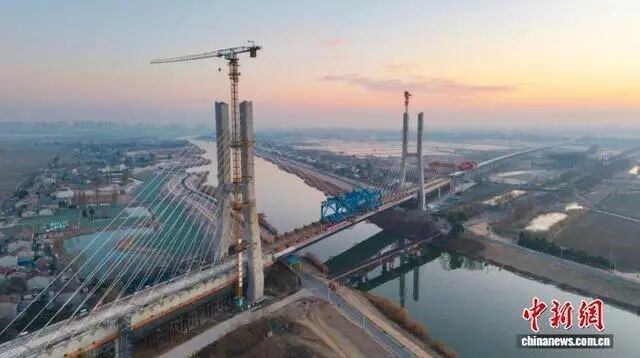
The Grand Bridge and its approach works have a total length of 14.186 km. The crossing Chu River cable-stayed bridge that was closed this time is 502 m long and features a double tower, five span hybrid girder cable stayed bridge design. Located within the scenic belt along the Chu River, the site conditions are complex and the technical requirements are demanding, with exceptionally high standards for alignment control and positioning accuracy.
According to Geng Xuqiu, Chief Engineer of the Second Sub division of Section 2 for the Nanjing Hub Project on the Shanghai–Nanjing–Hefei High-Speed Railway of China Railway Shanghai Engineering Bureau Group Co., Ltd., the bridge adopts a combined structural scheme of prestressed concrete girders, a steel concrete composite segment, and a steel box girder. The steel box girder in the main span offers high strength and low self-weight, meeting navigation clearance requirements. During construction, intelligent safety control equipment, including tower crane stress monitoring, deck crane stress monitoring, and harmful gas concentration monitoring, was deployed to enable dynamic, real-time supervision throughout the process.
As an important component of the Yangtze River corridor of China’s “Eight Vertical and Eight Horizontal” high speed railway network, the Shanghai–Nanjing–Hefei High Speed Railway forms the eastern section of the Shanghai–Chongqing–Chengdu High Speed Railway. The line starts at the newly built Shanghai Baoshan Station, passes through Suzhou, Nantong, Taizhou, Yangzhou and Nanjing in Jiangsu Province, and Chuzhou and Hefei in Anhui Province, and connects to the existing Hefei South Station. The route is approximately 554 km in length, with a design speed of 350 km/h and 16 stations along the line. Upon completion, the project will play an important role in advancing the “Railway based Yangtze River Delta” initiative and optimizing the railway network layout in the Yangtze River region.
Editor's Choice


Get the latest updates with our newsletter
Follow us
-

CCPA Wechat
-

CCPA EXPO Wechat
