




100% Recycled Coarse Aggregate—Guangxi University Completes the Region's First Full-Replacement Recycled Concrete Project
Recently, the main structure of the Civil Engineering Comprehensive Experimental Center at Guangxi University was successfully topped out.
Recently, the main structure of the Civil Engineering Comprehensive Experimental Center at Guangxi University was successfully topped out. The project is Guangxi's first in-situ demolition and reconstruction demonstration project, with its core structure achieving 100% recycled coarse aggregate replacement. By harnessing scientific research to enable green construction, it offers a replicable model for the low-carbon transformation of the building industry.
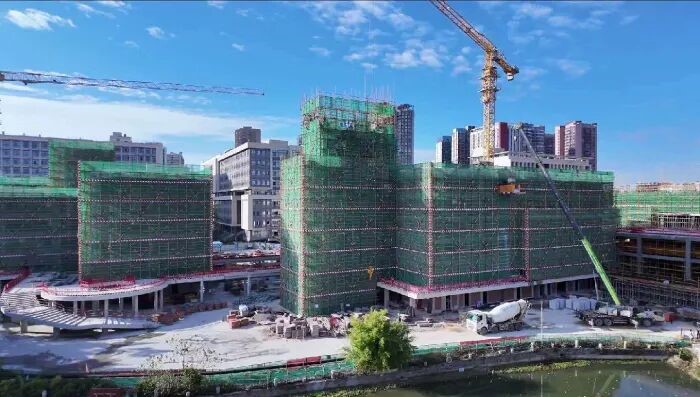
The project innovatively adopts an "in-situ demolition, closed-loop utilization" approach, crushing and processing waste concrete from the original old laboratory into high-quality recycled aggregate, which is then reused in the core structural components of the newly built experimental center on the same site, achieving the resourceful utilization of construction solid waste.
Professor Xiao Jianzhuang's team at Guangxi University has focused on performance regulation and large-scale application of recycled concrete, systematically overcoming key technical challenges related to mechanical performance and durability. In this project, 100% recycled coarse aggregate concrete was applied at scale to core structural elements — including beams, slabs, and columns on floors two through six of Building A — covering an application area of 3,000 m2. This marks the transition of the technology from laboratory research to engineering practice. The project has a total floor area of over 50,000 m2 and a total investment of approximately 200 million yuan. Through in-situ recycling, it significantly reduces construction waste landfilling and natural sand and gravel extraction, lowers carbon emissions and environmental impact, and responds to the carbon peaking and carbon neutrality goals.
As Guangxi's first full-replacement recycled concrete project, its technical approach and implementation model serve as a demonstration for urban renewal and green construction across the region and throughout the country. The project is expected to be completed and delivered in 2026.


Get the latest updates with our newsletter
Follow us
-

CCPA Wechat
-

CCPA EXPO Wechat
