




Construction Begins on China's Large-Span Earth-Anchored Road-Rail Spatial Cable Suspension Bridge
On March 11, the excavation of the east anchorage foundation pit for the Huangjueping Yangtze River Bridge officially commenced.
On March 11, the excavation of the east anchorage foundation pit for the Huangjueping Yangtze River Bridge officially commenced. This marks the formal start of construction for the bridge project, which is being built by Chongqing Urban Investment Infrastructure Construction Co., Ltd. and jointly designed by China RAILWAY MAJOR BRIDGE Reconnaissance & Design Institute Co., Ltd. and Chongqing Design Group Co., Ltd.
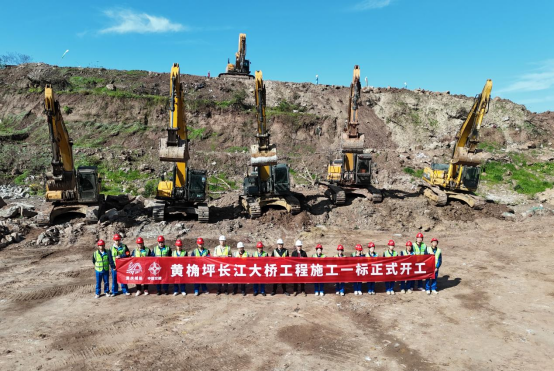
The Huangjueping Yangtze River Bridge is a crucial component of Chongqing's Eighth Horizontal Expressway. Spanning approximately 2.9 km, it stretches from the Jiulong Peninsula in Jiulongpo District in the west to the Ertang Interchange in Nan'an District in the east. Located just south of the Chongqing East Railway Station, it serves as a direct westbound radiation corridor for the station. It not only undertakes the traffic dispersion task from the East Station to central core areas like Jiulongpo, Dadukou, and Shapingba, but also densifies the road network in the urban core area, precisely matching the growing traffic demand of crossing the Yangtze River and passing through Tongluo Mountain. Once completed, the bridge will significantly divert traffic pressure from the Fourth Horizontal Expressway, injecting strong momentum into the balanced development of urban space.
"The Huangjueping Yangtze River Bridge represents a 'tailor-made' exploration by our design team. To accurately implement these functions and overcome complex construction conditions, the design team integrated multiple innovations into the scheme, making the design of the Huangjueping Yangtze River Bridge highly distinctive. Once completed, the Huangjueping Yangtze River Bridge will become the world's largest-span earth-anchored road-rail spatial cable suspension bridge," introduced He Tieming, the project manager of the bridge.
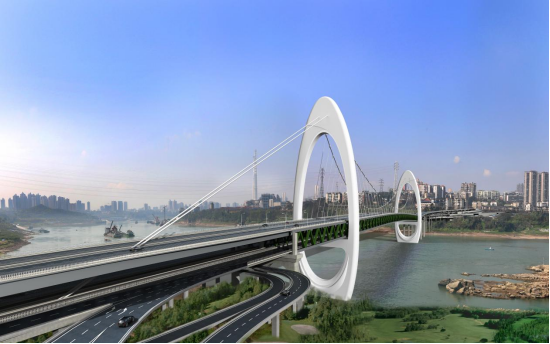
The bridge tower features an ingenious architectural design—modeled after the "bud" of the ficus virens (Huangjue trees), Chongqing's city tree. This is not only a tribute to the regional culture of Huangjueping but also a deep exploration of the bridge's humanistic connotation.
The main bridge has a total length of 752 m and a standard deck width of 39.9 m. With a main span of 550 m, it is a single-span suspended twin-tower earth-anchored spatial cable suspension bridge. It innovatively adopts a double-deck design—the upper deck features a dual-way 6-lane urban expressway, pedestrian walkways, and water supply pipelines, realizing multiple functions crossing the river on the same bridge; the lower deck accommodates a dual-way 6-lane urban arterial road and a 2-line rail transit system, making full use of the bridge space to achieve highly efficient road-rail co-construction.
To adapt to the complex boundary conditions of urban bridge construction, the design team creatively reduced the transverse distance between the two main cables at the anchor span and arranged the approach bridges separately. The main cables pass between the two approach bridges and share a single anchor body. This reduced the anchorage land area, achieved highly efficient and intensive use of land resources, and successfully solved the construction challenges of tight coastlines and restricted land use in the urban core. It also significantly reduced the disturbance to existing buildings and ecological green spaces on both banks, balancing engineering construction with the synergistic protection of urban space.
To address the pain points of ultra-wide transverse span and uneven load distribution caused by the double-deck design, the stiffening girder innovatively adopts a continuous truss structure. By adding a middle main truss in critical load-bearing sections, it achieves a smooth transition and continuous connection of the truss structure from double to triple trusses. This not only resolves local stress concentration problems but also significantly enhances the structure's torsion resistance and wind stability. This design breaks free from the spatial dilemmas of urban bridge construction and provides new ideas for the highly efficient utilization of similar cross-river bridges.
Aiming at the large spatial effect generated by the spatial cable plane layout, the design team innovatively optimized the design of key load-bearing components—both ends of the suspender cables are equipped with large-angle spherical plain bearings similar to "arm joints." Their flexible rotation characteristics can fully meet the large-angle longitudinal and transverse rotation demands of spatial suspender cables during construction erection and long-term operation, effectively releasing structural deformation stress.
The main cable saddle adopts a rigid rotating structure to ensure stable and precise load transmission of the main cables, while the cable-spreading saddle uses an adaptive design that can actively offset the transverse horizontal component force generated by the two main cables, avoiding safety hazards caused by load deviation in the structure.
The Huangjueping Yangtze River Bridge project is more than just a cross-river transport facility; it is an important carrier for promoting regional synergy and optimizing urban functional layouts. Its completion will further strengthen Chongqing's core competitiveness and radiation influence within the "Belt and Road" initiative and the Yangtze River Economic Belt, injecting energy into the coordinated development of the Chengdu-Chongqing Economic Circle, and becoming an important transportation engine empowering high-quality regional development.


Get the latest updates with our newsletter
Follow us
-

CCPA Wechat
-

CCPA EXPO Wechat
