




Heavyweight News from the Yangtze River Delta's “Mega Infrastructure”
 Printing
The recently announced draft outline of the “15th Five-Year Plan” explicitly proposes advancing the Shanghai-Ningbo (Hu-Yong) Cross-Sea Channel project. Consequently, this cross-sea super project, which has been planned for over a decade, will be incorporated into national-level planning, and its project schedule is expected to hit the “start button.”
There is heavyweight news regarding the “mega infrastructure” in the Yangtze River Delta. The recently announced draft outline of the “15th Five-Year Plan” explicitly proposes advancing the Shanghai-Ningbo (Hu-Yong) Cross-Sea Channel project. Consequently, this cross-sea super project, which has been planned for over a decade, will be incorporated into national-level planning, and its project schedule is expected to hit the “start button.”
Aim to Break Ground During the “15th Five-Year Plan” Period
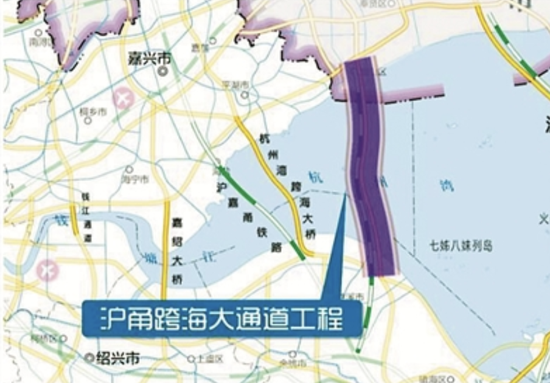
The most significant feature of the Shanghai-Ningbo Cross-Sea Channel is its “direct connection.” The “trumpet-shaped” Hangzhou Bay separates Shanghai from southeastern Zhejiang. Although Shanghai and Ningbo face each other across the sea and the straight-line distance is not far, traveling between them is not very convenient. Currently, the high-speed rail from Ningbo to Shanghai must first head west through Hangzhou, then turn northeast to Shanghai. The route forms a “C” shape, taking about an hour and a half at its fastest.
The Hangzhou Bay Bridge, opened in 2008, is a highway bridge connecting Ningbo and Jiaxing. Via this bridge, the driving distance from Ningbo to Shanghai is over 200 km. At present, the bridge's traffic volume is nearing saturation. The Hangzhou Bay Cross-Sea Railway Bridge, which began construction in 2022, is a key project for the Nantong-Suzhou-Jiaxing-Ningbo High-Speed Railway and is currently the world's longest high-speed railway cross-sea bridge under construction. After the Nantong-Suzhou-Jiaxing-Ningbo High-Speed Railway opens to traffic, the fastest travel time from Ningbo to Shanghai will be around 1 hour, but it will still need to pass through places like Jiaxing.
A comparison has been made: among the Yangtze River Delta city clusters, metropolitan areas such as Nanjing, Hangzhou, Hefei, and Suzhou-Wuxi-Changzhou have all achieved direct high-speed rail connections with Shanghai, while traveling from the Ningbo metropolitan area to Shanghai still requires a detour. In contrast, the Shanghai-Ningbo Cross-Sea Channel will enable a “point-to-point direct connection.”
The channel is preliminarily planned to be built in the sea area approximately 20 to 40 km east of the Hangzhou Bay Bridge. It will cross Hangzhou Bay in an almost straight path, connecting Jinshan in Shanghai and Cixi in Ningbo. According to planning documents, the road-rail combined Shanghai-Ningbo Cross-Sea Channel will have a total length of nearly 70 km. Based on public information, it is likely to become “China's longest cross-sea bridge.” After being included in the plan, relevant national and local departments will initiate preliminary research work for the project. Zhejiang has already made it clear in its "15th Five-Year Plan" outline to “Break Ground During the ‘15th Five-Year Plan’ Period”.
Editor's Choice


Get the latest updates with our newsletter
Follow us
-

CCPA Wechat
-

CCPA EXPO Wechat
