




Application prospect of UHPC materials in prefabricated bridges
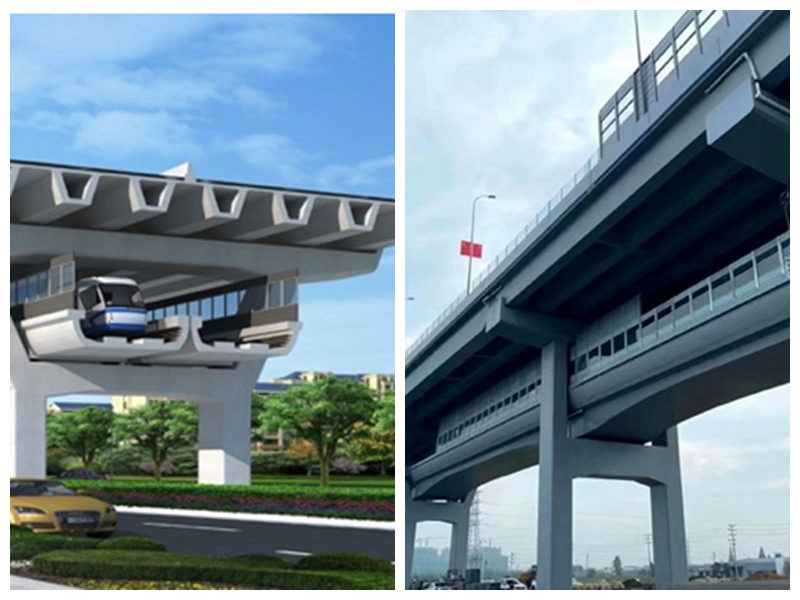
Assembly is the main feature of bridge industrialization, and it is also the direction of upgrading and strategic industries development of China's construction field during the 13th Five-Year Plan.
1. Foreword
Assembly is the main feature of bridge industrialization, and it is also the direction of upgrading and strategic industries development of China's construction field during the 13th Five-Year Plan. In September 2016, the State Council issued the “Guiding Opinions of the General Office of the State Council on Vigorously Developing Prefabricated Buildings”, striving to make the proportion of prefabricated buildings in new buildings reach 30% within 10 years.
Small and medium span prefabricated bridges play an important role in China’s bridge construction. According to the statistics of the Ministry of Transport, by the end of 2017, there were 832,500 highway bridges in China, of which 736,100 were medium and small span bridges, accounting for 88.4%. Promoting the development of prefabricated small and medium-span bridges is of great significance for promoting the transformation of bridge construction methods, improving engineering quality, shortening construction period, reducing labor intensity and cost, saving energy and protecting environment, etc.
2. Technical Bottleneck
At present, there are three types of prefabricated bridges: prefabricated concrete beams (hollow slabs, T beams, small box beams, etc.), prefabricated steel-concrete composite beams and prefabricated steel box girders. However, a large number of engineering practices show that the existing prefabricated bridge structure still has the following two main technical bottlenecks:
2.1 Given the heavy existing prefabricated bridge structure hoisting weight, or the heavy field construction work, the prefabricated level needs to be further improved: the prestressed concrete beams (hollow slab, T beam and small box beam) have large self-weight and span of over 30 m, and the beam weight is too large, which requires higher transportation and hoisting equipment and construction safety, resulting in the difficulty in implementing the prefabricated construction of large-sized components; Conventional concrete beams and steel-concrete composite beam bridge panels have a large amount of field work and a long construction period. There is a large amount of welding on site for steel box girder, and the construction quality is difficult to control. Therefore, there is still room for improvement in the prefabricated construction level of the above-mentioned conventional structures.
2.2 The beams and connecting nodes of the existing prefabricated bridge structure are easy to crack, damage and leak, with poor durability and high maintenance cost in the later period. Transverse connection joints of prestressed concrete beams (hollow slab, T beam and small box beam) are weak links, which are prone to failure and cracking, resulting in stress on single beam (slab), and are prone to technical problems such as leakage. The bridge deck in the negative moment zone of steel-concrete composite beams is prone to cracks in the actual operation stage, and the infiltration and erosion of rainwater will affect the safety and durability of the structure. The box girder adopts the traditional orthotropic steel bridge deck system, which has the problems that the steel deck is prone to fatigue cracks and the steel deck pavement is easily damaged. The above-mentioned diseases lead to high maintenance cost of conventional structures in later period.
Generally speaking, there is still much room for improvement in construction performance, service performance and durability of existing prefabricated bridges. Facing the realistic demands of standardization, assembly and industrialization of bridges, it is an important development trend to develop high-performance prefabricated bridge structures with high construction performance, high service performance and high durability on the basis of existing small and medium-span bridge structures.
3. Ultra-high performance concrete
Ultra-high performance concrete (UHPC) is composed of cement, silica fume, fine aggregate, high efficiency water-reducing agent, steel fiber and other materials, and is constructed according to the principle of maximum compactness, so as to minimize the internal defects (pores and micro-cracks) of the materials, thus obtaining excellent mechanical properties and durability.
The research shows that the steel fiber dispersed in UHPC can greatly slow down the propagation of micro-cracks in the material, which makes the material show ultra-high toughness and ductility. At the same time, due to its compact structure and low porosity, the durability of UHPC material can reach more than 200 a.
Because UHPC has super high strength, under the same bearing capacity, the size of UHPC structure is between ordinary concrete structure and steel structure and close to the latter. Therefore, when UHPC is applied to practical engineering, it can greatly reduce the cross-section size and the dead weight of the structure, and is beneficial to assembly construction.
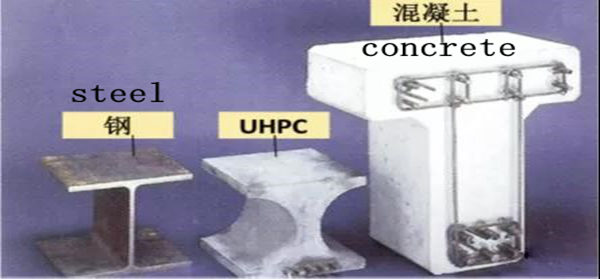
With the introduction of UHPC, it is expected to bring revolutionary changes to the traditional prefabricated medium and small span bridge technology and realize the high performance of prefabricated bridges.
3.1 Under the condition of equal strength bearing, the dead weight can be reduced to 40% ~ 60% of the traditional structure, so as to facilitate transportation and realize rapid erection of large components.
3.2 Because the anchorage length of steel bar in UHPC is only 10 times of the diameter of steel bar, the joint between beams on site can be greatly reduced, and zero welding on site can be realized as well.
3.3 The structure has excellent anti-corrosion, anti-freezing and anti-leakage performance, and basically realizes maintenance-free within the design life cycle of the structure.
4. Existing problems at present
4.1High requirements for preparation conditions
4.2 High production cost
4.3 Shrinkage
5. Conclusion
The introduction of UHPC, a high-performance material, into prefabricated bridges with medium and small spans to achieve high performance is expected to basically solve the technical problems of existing structures, realize the sustainable development strategy of high construction performance, high service performance and high durability of structures, and end the traditional "extensive" construction mode with high labor intensity and high energy consumption, which is in line with the current national policy-oriented development of prefabricated buildings and the overall goal of vigorously promoting the "Supply-side Structural Reform" in the construction field, and is an important way to improve the construction quality of bridge structures in China.


Get the latest updates with our newsletter
Follow us
-

CCPA Wechat
-

CCPA EXPO Wechat
