




Winners of 2020 CCPA Concrete Science and Technology Award (Theoretical Research 01) By Wuhan University of Technology
The project of “Design and Properties Control of Ultra-High Performance Fibre Reinforced Concrete Based on Particle Packing Theory” by Wuhan University of Technology won the second prize of 2020 CCPA Concrete Science and Technology Award (Technology Innovation).
In the ultra-high performance concrete (UHPC) system, the formation of the closest internal accumulation is the basis to ensure its excellent performance. At present, there is no the guidance of systematic and comprehensive accumulation theory for the design of UHPC, and the design guidance of fiber, water and water reducer is not fine enough, which easily leads to the problems of poor uniformity, insufficient compactness, low fiber utilization, high energy consumption and high cost of the prepared concrete.
Starting from the optimization design of UHPC, this project puts forward the closest particle packing design theory of UHPC based on all material scale. By introducing solid wastes such as recycled aggregate, machine-made sand, slag, tailings and stone powder, cement and other high energy consumption components is partly replaced in UHPC without damaging the UHPC particle packing system, which not only ensures its excellent performance, but also realizes the recycling of solid wastes, and reduces the energy consumption and cost of UHPC.
Research achievements and scientific research value of the project are as follows.
Research achievement- Research and optimized design of particle packing system for UHPC materials
Design theory of closet particle packing of UHPC in full material scale is developed. Based on the different forms of dry packing density and wet packing density, the basic model of UHPC optimized design is constructed, and the intelligent UHPC mix proportion design software which can adapt to raw materials with different physical and chemical characteristics is developed.
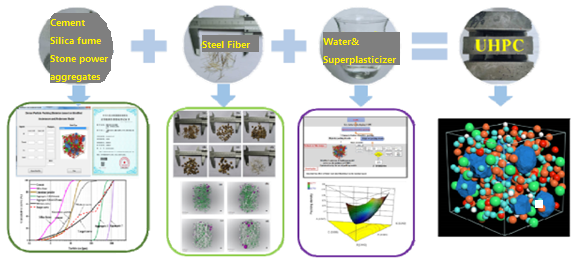
Design theory of closet particle packing of UHPC in full material scale
Research achievement- Ecological UHPC design theory
The design theory of ecological UHPC based on the principle of the closest particle packing theory is proposed. This method not only ensures the excellent performance of UHPC, but also fully recovers solid waste and reduces the energy consumption and cost of UHPC. For example, the design theory of introducing waste recycled aggregate into UHPC system is proposed, and UHPC is prepared with high phosphorus slag instead of cement, realizing low energy consumption, low carbon emission and low cost purpose.
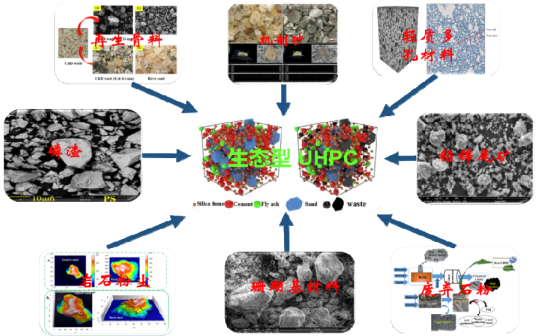
Ecological UHPC design theory
Research achievement- Fiber dynamic process and regulation of fiber in meso parameters in UHPC
The project studied the fiber dynamic process and regulation mechanism in UHPC, creatively analyzed the fiber orientation by computer image analysis tools, and verified the key factors affecting fiber orientation and distribution in fresh UHPC. At the same time, the research on the relationship between fiber micro parameters and concrete macro properties illustrates the influence of fiber content on the macro properties and microstructure of UHPC, which provides some guidance for the follow-up research in this direction.
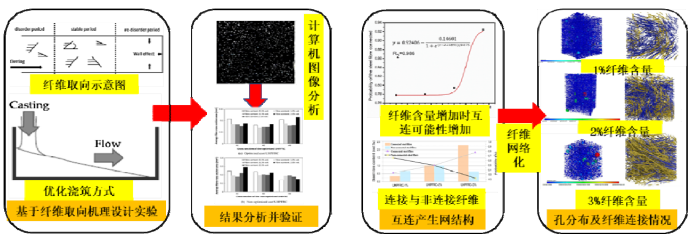
Fiber dynamics model and fiber lapping mechanism
Research achievement- Mechanism and optimal regulation of UHPC volume stability
The project studied the mechanism of UHPC volume stability, adopted a new lightweight aggregate system to solve the shrinkage problem of concrete. Based on the carrier effect of porous lightweight aggregate, the shrinkage reduction mechanism of porous aggregate is studied, which effectively improved the volume stability of UHPC.
Research achievement- Durability control technology of UHPC in severe environment
In the severe environment such as ocean, the durability of concrete has become the key parameter. The research group of marine environmental concrete (UHPFRC) summarized and summarized the influence of steel fiber content on the durability of concrete, which laid a theoretical foundation and data support for subsequent research.


Get the latest updates with our newsletter
Follow us
-

CCPA Wechat
-

CCPA EXPO Wechat
