




A Mega Water Conservancy Project with a Total Investment of 57.4 Billion Yuan Is About to Launch
Recently, the People's Government of Sichuan Province issued a public notice titled “Investment Promotion Conference for Introducing Private Capital into the Daduhe-to-Minhe River Project”, signaling the upcoming launch of another major water infrastructure initiative.
In recent years, China’s investment in water conservancy construction has repeatedly hit record highs, surpassing the trillion-yuan threshold for three consecutive years, with multiple major water projects breaking ground one after another. Recently, the People's Government of Sichuan Province issued a public notice titled “Investment Promotion Conference for Introducing Private Capital into the Daduhe-to-Minhe River Project”, signaling the upcoming launch of another major water infrastructure initiative.
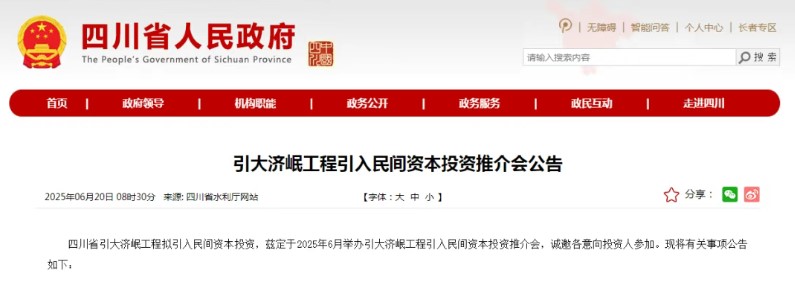
According to the announcement, the investment promotion conference is scheduled for June 2025, with an open invitation extended to prospective investors. The Daduhe-to-Minhe River Project involves a total estimated static investment of 57.4 billion yuan and a planned construction period of 96 months. The project's main objective is to divert water from the Dadu River to the Chengdu Plain, forming a water resource allocation system centered on the Dujiangyan and Daduhe-to-Minhe River Project. It will prioritize urban and industrial water supply while also accommodating agricultural irrigation needs. Water will be drawn from the reservoir of the Luding Hydropower Station on the Dadu River, with a designed intake flow of 80 cubic meters per second. The total length of the water transmission route will be 304.4 kilometers, including three hydropower stations designed for energy recovery, with a combined installed capacity of 388 megawatts. (Final project specifications are subject to approval by the National Development and Reform Commission.)
Rapid Growth in National Water Conservancy Construction
According to public data, in 2021, China completed 757.6 billion yuan in water conservancy investment. In 2022, investment reached 1.0893 trillion yuan, a 43.8% year-on-year increase—marking the first time water investment surpassed one trillion yuan. In 2023, the investment climbed further to 1.1996 trillion yuan. By 2024, the figure reached 1.3529 trillion yuan, representing a 12.8% year-on-year growth. That year also saw the commencement of 41 major national water network projects and the implementation of 46,967 water conservancy projects.
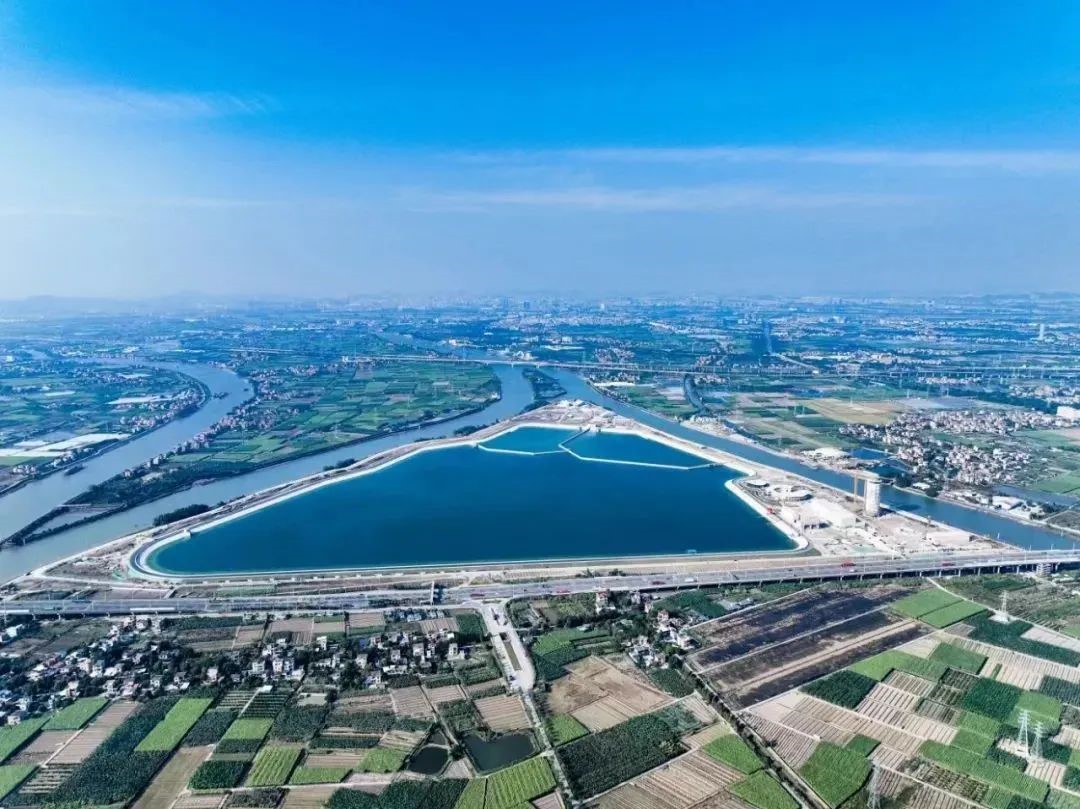
Highlights by Year:
2021
The Eastern and Central routes of the South-to-North Water Diversion Project completed 146 out of 155 design units (94.2%). Preliminary designs for six key projects, including Yulong Kashi and Phase II of the Hanjiang-to-Weihe River Project, received approval. Notable progress included water storage at reservoirs such as Dongtaizi in Inner Mongolia, Dongzhuang in Shaanxi, Jiangxiang in Anhui, Hongyudong in Sichuan, Huangjiawan in Guizhou, Gaopo in Guangdong, and Dashimen in Xinjiang.
Major supply projects, including Phase II of the Gansu Taohe River Water Diversion and Supply Project and the Northern Hubei Water Allocation Project, achieved full connectivity. Twenty major projects, including the Jingjiang Levee Rehabilitation Project, the Nenjiang Ni’erji Water Control Project, and the Zhuangli Reservoir in Shandong, passed final inspections.
2022
The Yangtze-to-Hanjiang Project of South-to-North Water Transfer Middle Route Project began construction, accelerating the backbone structure of the national water network.
Construction began on the second phase of the Huai River-to-Sea Canal, a strategically significant component for flood control. After years of planning, the Guangdong Coastal Water Resources Allocation Project in the Beibu Gulf region broke ground—set to fundamentally resolve water shortages in western Guangdong, especially on the Leizhou Peninsula.
Several major water projects reached key milestones, including trial water diversion and navigation for Phase I of the Yangtze-to-Huai Project, normal water level impoundment at the Datengxia Water Control Hub, full tunnel completion for the Han-to-Wei Project through the Qinling Mountains, and the successful completion of the Northern Hubei Water Allocation Project.
2023
Groundbreaking ceremonies were held for 44 major projects, including the Jilin Water Network Backbone, the Heilongjiang Grain Output Enhancement Water Project, the Xiong’an Main Canal, and the Guangxi Beibu Gulf Water Allocation Project.
Several projects reached critical stages: the Datengxia Water Control Hub on the Xijiang River completed its main structure; trial water delivery started on the Han-to-Wei and Yangtze-to-Huai projects; the Guangdong Pearl River Delta Water Allocation Project achieved full-line water transfer capability.
The basin-wide flood control system continues to improve, with new projects launched across key regions. In the Yangtze River Basin, construction has commenced on reservoirs such as Yaojiaping and Fenghuangshan, the river channel improvement project in the Anqing section of the Yangtze mainstream, as well as flood detention and storage areas including Kangshan in Poyang Lake and Zhuhu Lake.
The Yellow River region advanced the Dongzhuang and Wangyao reservoir expansion projects, along with downstream flood control efforts. The Huaihe River region launched key floodplain and retention basin projects, and the second phase of the Huai River-to-Sea Canal accelerated construction.
2024
As of the 10th anniversary of full operation, the Eastern and Central routes of the South-to-North Water Diversion Project had transferred 77.16 billion m3 of water with stable and compliant water quality. A national platform for modern reservoir operation and management was essentially completed, with 8,246 reservoirs included in the matrix system.
The basin-wide flood control system is being rapidly enhanced. In the Yangtze River Basin, key projects include the construction of the Xuanwei Reservoir, river channel regulation along the Tongling section of the main stream, and the development of the Kangshan flood detention area in Poyang Lake. In the Yellow River Basin, major initiatives involve the construction of the Jiangjiayaoze Reservoir and regulation works along the Ningxia section of the river's main stream.
Ecological protection and restoration efforts are being actively advanced in key water bodies, including the Danjiangkou Reservoir area and its upstream river systems. Comprehensive measures to control soil erosion are being implemented in the black soil region of Northeast China, while integrated initiatives to curb groundwater over-extraction are being vigorously promoted in North China.


Get the latest updates with our newsletter
Follow us
-

CCPA Wechat
-

CCPA EXPO Wechat
