




Another Yangtze River Bridge Achieves Successful Closure
Recently, the Zhijiang Yangtze River Bridge, the world's longest-span steel-UHPC composite girder cable-stayed bridge, achieved closure of its main span.
Recently, the Zhijiang Yangtze River Bridge, the world's longest-span steel-UHPC composite girder cable-stayed bridge, achieved closure of its main span. The bridge has a total length of 1,549 m, a main span of 890 m, and main towers rising 257.5 m high. It is currently the world’s largest steel-UHPC composite girder cable-stayed bridge under construction.
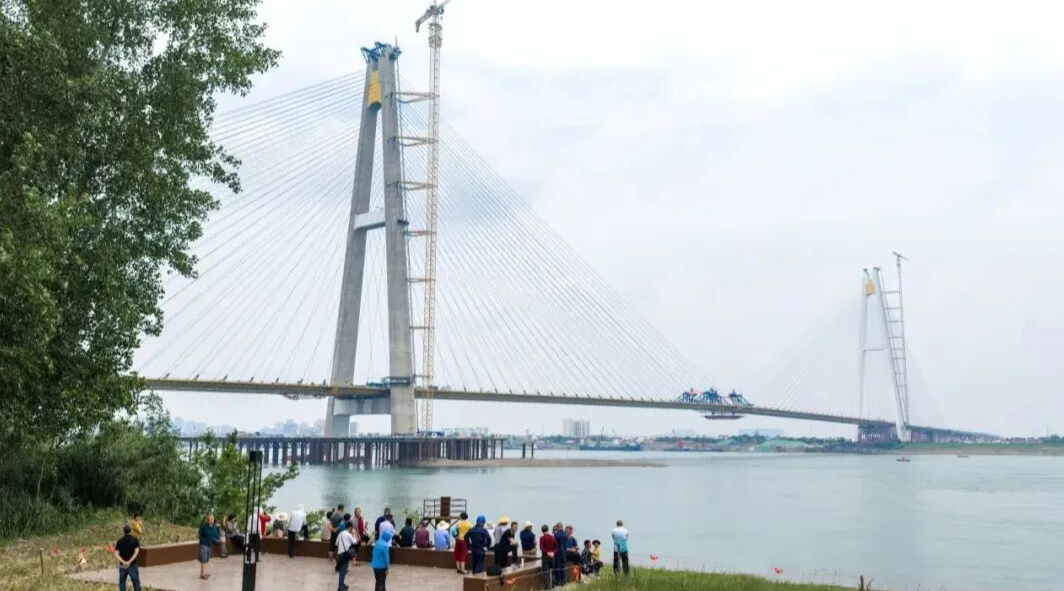
The bridge is being jointly constructed with the participation of CCCC Second Highway Engineering Co., Ltd. The closure segment completed this time measures 6.95 m in length, 47.5 m in width, and weighs 148 t. Installing this segment represented the most technically challenging and precision-demanding stage of the entire project, comparable to assembling an enormous set of building blocks with extraordinary accuracy hundreds of meters above the ground.
The bridge consists of 91 girder segments, with the heaviest weighing nearly 600 t. To achieve precise lifting and assembly over the Yangtze River, construction teams had to avoid passing vessels while coping with changing water conditions, strong winds, and adverse weather. To address these challenges, the project team developed a new lightweight deck crane, which not only reduced equipment costs but also significantly improved lifting efficiency and installation accuracy. The project also employs the BeiDou intelligent monitoring system and 3D digital pre-assembly technology, enabling round-the-clock real-time monitoring of the bridge’s structural geometry and stress data, making the entire construction process visible and controllable.
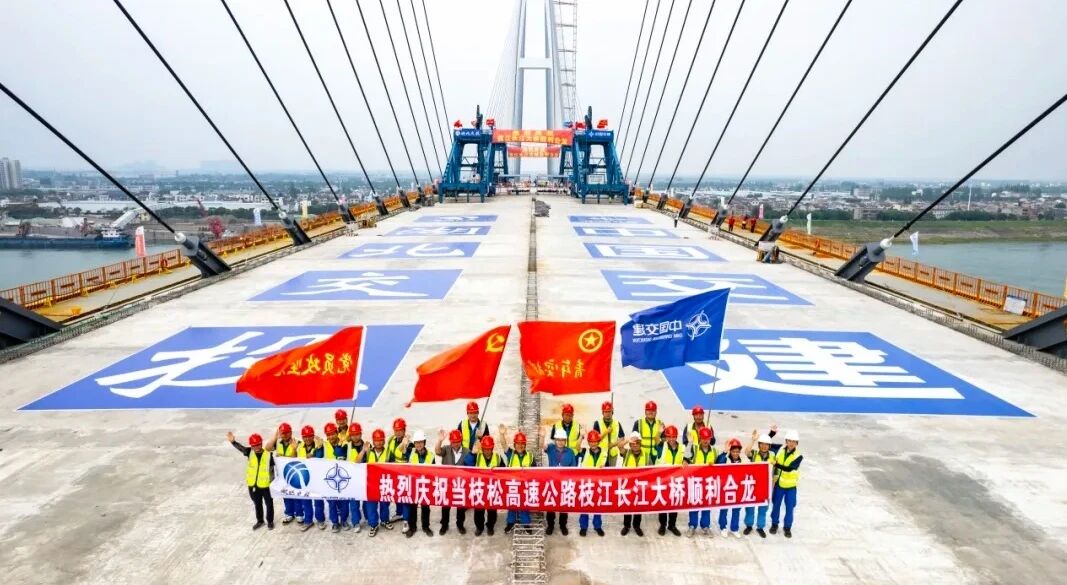
During the closure operation, the project team continuously monitored ambient temperature, girder temperature, and cable force variations in real time. By comparing field measurements with theoretical models and simulating different temperature-difference scenarios between the upper and lower structures, engineers accurately identified an optimal construction window at 16.8°C. Guided by the intelligent monitoring system’s precise “navigation,” the bridge achieved a closure accuracy of 5 mm, far exceeding the required standard of 20 mm.
To meet the public’s diverse travel needs, a 4.5-meter-wide non-motorized and pedestrian pathway system has been incorporated on both sides of the bridge. This makes it the first expressway bridge in Hubei Province equipped with a dedicated pedestrian slow-traffic system.


Get the latest updates with our newsletter
Follow us
-

CCPA Wechat
-

CCPA EXPO Wechat
